

One Test Plan Review Saved a Supermajor Operator Over $40,000 per BOP Test; Projected Savings Over $700,000 a Year Based on 21-Day Test Requirements and Similar Test Parameters
The Challenge: The Rising Cost of Offshore BOP Testing
Blowout preventer (BOP) testing, the pressure testing process that verifies well control equipment can hold and seal against design pressures, is a recurring, non-negotiable requirement for every offshore drilling operation, mandated by the Bureau of Safety and Environmental Enforcement (BSEE) in U.S. Gulf of America waters under 30 CFR Part 250, governed by API Standard 53 internationally, and enforced by host-country regulators like Brazil’s ANP (Agência Nacional do Petróleo, Gás Natural e Biocombustíveis). These regulations define minimum test frequencies, pressure requirements, hold times, and documentation standards. Frequency varies by jurisdiction: Gulf of America operations are required to test every 21 days; offshore programs in Guyana and much of South America typically test monthly.
What’s consistent across all jurisdictions is the cost exposure. Offshore rig spread rates—encompassing the drilling unit, support vessels, helicopter logistics, and contracted services—routinely exceed $500,000 per day and can surpass $1 million per day for deepwater and ultra-deepwater operations. At a $1 million/day spread rate, a single hour of rig time carries a value of about $41,667. Every inefficient step in a BOP test procedure converts directly into non-productive time (NPT) and measurable budget exposure.
| At a $1 million/day spread rate, one hour of rig time represents over $41,000 in operational cost. Across a multi-year drilling program with recurring BOP tests, even marginal inefficiencies compound into significant budget exposure. |
The best place to find savings is the critical path: the sequence of steps in the test procedure where any delay directly extends total test duration and, consequently, rig cost. Optimizing these steps by eliminating redundancies, resequencing activities, and removing steps that add no regulatory or operational value is the most impactful intervention available to the engineering team.
The IPT Global Approach: Optimizing the BOP Test Plan with TestPlanner
A Supermajor operator conducting offshore drilling operations in South America engaged IPT Global’s Real-Time Operations Center (RTOC) to conduct a comprehensive review and optimization of the rig’s existing BOP test plan. The RTOC team employed SureTec® PressureTesting’s TestPlanner module to carry out the analysis, pairing the platform’s automated capabilities with hands-on engineering expertise.
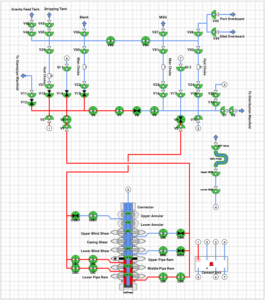
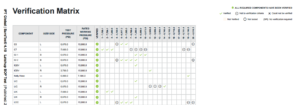
TestPlanner gives engineers a smart, interactive P&ID environment purpose-built for pressure testing and well control equipment. Its built-in PressurePath logic dynamically visualizes how pressure moves through the system and flags trapped pressure zones, while engineers configure valve line-ups and pressure sources in real time. Automated compliance coverage analysis confirms that every component is tested to the correct pressure requirement, surfacing exactly where a test plan can be safely streamlined.
Drawing on this analysis and on decades of hands-on experience across deepwater and shelf programs, multiple rig classes, and regulatory jurisdictions worldwide, the IPT Global RTOC engineering team applied TestPlanner’s findings to identify precisely where test procedures could be optimized, without compromising well control integrity or compliance.
The optimization followed a structured methodology:
- Detailed review of the existing BOP test plan in its entirety, step by step
- Identification of the 14 critical path steps directly impacting overall test duration
- Assessment of each step for regulatory necessity, operational sequencing logic, and potential for consolidation or elimination
- Delivery of a revised, optimized test plan with full technical rationale for each modification
Throughout the process, TestPlanner’s compliance coverage analysis (validated by the RTOC engineering team) maintained strict alignment with applicable regulatory standards, ensuring every modification preserved full compliance while eliminating procedural steps that added time without adding safety or regulatory value.
| “I didn’t think this plan had room to tighten up, but IPT Global’s TestPlanner and their RTOC team found two critical path steps we could cut with no impact to testing the integrity of our well control equipment. This was a big win for us.” – Wells Operations Supervisor |
The Results: Two Critical Path Steps Removed, Full Compliance Maintained
The IPT Global RTOC team’s use of TestPlanner produced measurable results realized immediately upon test execution. Most notably, eliminating two critical path steps without compromise to regulatory compliance or well control integrity.
| >30 Min
Avg. Step Duration |
14 → 12
Critical Path Steps Reduced |
>1 Hour
Critical Path Time Saved |
>$40,000
Rig Time Cost Savings Per Test |
A one-time optimization delivers recurring returns. Because BOP tests are mandated at regular intervals, the savings realized on the first execution of the revised plan repeat with every subsequent test on the same rig, effectively delivering a perpetual return on a single optimization engagement.
Testing frequency amplifies the impact. The table below applies the per-test savings across the testing schedules most common in two of the industry’s most active offshore markets:
| Region / Frequency | Tests Per Year | Estimated Annual Savings |
| Gulf of America (every 21 days) | 17 | Over $700,000 |
| Guyana / South America (monthly) | 12 | Over $500,000 |
These projections assume a consistent $1 million/day spread rate and apply directly to any drilling program operating under a similar test plan. The optimization investment is made once; the return is realized on every test thereafter.
Key Takeaways
| 1 | Immediate and Recurring Value
The Supermajor operator realized over $40,000 in rig time savings on the first execution of the optimized test plan. Because BOP tests are recurring events, this benefit is not a one-time gain…it replicates across every subsequent test on this rig under similar circumstances. At Gulf of America testing frequency (every 21 days), that compounds to over $700,000 annually. For monthly testing programs such as those in Guyana, the figure exceeds $500,000 per year. |
| 2 | Compliance Without Compromise
Every modification to the test plan was validated against applicable regulatory requirements. The optimization eliminated procedural redundancy without sacrificing regulatory rigor, ensuring the rig continues operating with full confidence that its BOP testing program remains compliant with BSEE, API Standard 53, ANP, and all applicable governing standards. |
| 3 | A Software-enabled Service That Transfers Across Basins and Rig Classes
The analytical framework built into SureTec PressureTesting’s TestPlanner module, applied with IPT Global RTOC engineering support, is not specific to a single rig, operator, or basin. It applies across rig classes, water depths, regulatory jurisdictions, and geographic regions, including deepwater, shelf, and land-based surface BOP programs. Any operator conducting BOP tests is a candidate for this service, and the economics are most visible where spread rates are highest. |
Ready to recover rig time on your next BOP test? Contact IPT Global to learn how we can help you reduce NPT and drive measurable cost savings across your BOP testing program.