
Some digital pressure testing methods used in the oil and gas industry rely on predictive early data trends to draw conclusions about future performance. While these approaches may appear sophisticated, they often depend on assumptions that can be misleading. In safety-critical operations, the consequences of being wrong can be very dangerous.
At IPT Global, our approach is grounded in physics: how equipment actually behaves under pressure and an array of thermal variables. Our SureTec® PressureTesting Solution focuses on measurable system behavior rather than early-time trends and predictions, which provides greater assurance, protecting people, assets, and the environment.
During well control equipment pressure testing, a pressure decline can result from three distinct causes:
Why is this a problem? Because all three occur at the same time, and their combined effects appear as a single pressure curve making interpretation more challenging than it first appears.
Many digital pressure testing tools attempt to determine a pass or fail by observing how pressure decline slows over time. However, thermal and elastic effects naturally dominate early behavior and always attenuate. This early stabilization can create the appearance of improvement even when a real leak is present.
In short, early-time prediction alone does not confirm integrity, but rather introduces uncertainty at precisely the point where certainty is required.
Rather than predicting what might happen, IPT Global’s PressureTesting Solution models how a leak-free system should behave. We account for normal pressure changes caused by temperature and equipment expansion, establish a physics-based fingerprint for a healthy system, and evaluate subsequent tests against that baseline to identify true integrity failures.
Our focus is on delivering accurate, objective digital pressure testing results. In practice, that means fewer assumptions and clearer answers during the test itself. Instead of relying on trend-based prediction, we ask a more fundamental question: Does the observed behavior match that of a leak-free system?
A major offshore operator evaluated IPT Global’s physics-based PressureTesting Solution against a competing predictive pressure testing solution using real subsea BOP test data, including tests with confirmed visible leaks.
IPT Global correctly identified every known failure. The predictive solution, however, incorrectly passed multiple tests, including some with confirmed visible leaks.
A false pass, indicating equipment integrity when a failure exists, can expose operations to safety risks, environmental damage, unplanned downtime, and reputational harm.
Ultimately, when people, assets, and the environment are on the line, uncertainty should never be mistaken for insight. Physics-based analysis replaces assumption with understanding and delivers the confidence that safety-critical decisions demand.
If we all had one magical wish, many of us would choose the ability to see into the future—pick the right lottery numbers, avoid costly mistakes, or prevent accidents before they happen. But we don’t have that luxury. We never have.
Yet in well control equipment pressure testing, the industry relies on methods that attempt to predict future outcomes based on early-time trends. That raises an important question: why would we base assurance of critical safety barriers on a guess?
During BOP and Well Barrier Element (WBE) pressure tests, pressure decline is driven by three distinct physical mechanisms:
Only one of these—the integrity failure—is the condition we are trying to detect. The other two are benign, expected behaviors.
Mathematically, the observed pressure change can be expressed as:
ΔPObserved = ΔPThermal + ΔPElastic Expansion + ΔPIntegrity Failure
Each mechanism produces a unique pressure signature. In real operations, these signatures are superimposed, producing the single pressure curve we observe during a test. Accurately interpreting that curve requires understanding—and accounting for—these physical effects, not overlooking them.
Predictive analysis methods attempt to assess whether pressure loss is attenuating toward a leak-free system. The flaw is fundamental: thermal and elastic effects always dominate early-time behavior, and they always attenuate.
As a result, predictive methods often interpret early attenuation as improvement—creating a false sense of confidence. In early pressure test time, predictive analysis is not insight; it is inference based on incomplete physics.
There is no crystal ball. Early-time pressure test prediction is, by definition, a guess.
IPT Global does not attempt to predict the future. Instead, our PressureTesting solution with Thermally Compensated Leak Detection (TCLD) applies physics-based algorithms to establish a leak-free fingerprint for a specific BOP test configuration.
That fingerprint reflects the expected thermal and elastic response of the system. Subsequent tests on similar systems are then evaluated against this baseline to identify true integrity failures—quickly, objectively, and without relying on trend prediction.
So which approach would you trust: a black-box predictive trend or physics grounded in real behavior?
A major offshore operator compiled a dataset of more than 20 subsea BOP pressure tests from actual operations. The dataset included confirmed leaking tests—some identified visually by rig crews—and was used to evaluate both IPT Global’s PressureTesting and a competing predictive digital pressure testing solution.
The results were unambiguous:
Read that again. Predictive analysis passed tests that had already failed in the field, some with confirmed visual leaks.
These were not marginal cases or subjective interpretations. They were verified integrity failures that predictive software missed entirely—the exact outcome digital pressure testing is meant to prevent.
This is not an isolated result. Time and again, IPT Global’s physics-based PressureTesting solution has demonstrated superior accuracy by grounding interpretation in measurable system behavior rather than early-time trend speculation.
When IPT Global issues a pressure test pass, you can trust that your well control equipment or well barrier element is performing as intended.
When IPT Global issues a fail, you know you’ve identified a real problem—before it becomes a larger one.
The cost of a false pass is not just deferred downtime. It is a risk to people, assets, the environment, and the reputation of the operation itself.
SureTec PressureTesting reveals true leak signatures efficiently and objectively by isolating the physical behaviors that matter. This is not forecasting. It is physics-based, mathematically rigorous, and proven in the field where real consequences exist.
In digital pressure testing of Well Barrier Elements and Well Control Equipment, uncertainty should never be mistaken for insight. Predictive methods rely on early-time trends dominated by thermal and elastic effects, creating the illusion of improvement that disappears in late time.
IPT Global’s PressureTesting solution removes this ambiguity by accounting for all contributors to pressure decay in your specific system from the beginning of the test. The result is earlier, more reliable decisions based on understanding and proof—not a guess.
IPT Global: Industry leaders in digital pressure test accuracy and well barrier assurance.
When the operator introduced a new rig into the region, they quickly identified a performance gap in Blowout Preventer (BOP) testing. Rigs with several years of experience using IPT Global’s SureTec® PressureTesting solution consistently delivered faster and more reliable results. The new rig had not yet adopted the standardized digital pressure testing workflow required to achieve comparable performance.
The operator’s objective was to bring the new rig up to mature BOP testing performance as quickly as possible while maintaining verifiable well barrier integrity. Achieving this required shifting from variable manual processes to a consistent, documented digital pressure testing approach that reduced risk, minimized inefficiencies, and supported better operational decisions across the fleet.
IPT Global partnered with the operator to implement its PressureTesting solution, provide hands-on coaching, and establish standardized workflows. The result was a rapid improvement in safety and efficiency, with 210 documented pressure tests over the course of 14 months and significant reductions in critical path time early in the campaign.
Each well is unique, making direct comparisons in well barrier testing difficult. BOP testing provided the most practical benchmark because of its central role in safety and operational efficiency. The operator sought two outcomes: absolute confidence in barrier integrity and a reduction in high-pressure test times to minimize operational exposure and risk.
In addition, they wanted a consistent, documented pressure testing practice across the fleet, along with improved transparency between onshore support engineers and offshore execution teams. This was essential to minimize invisible lost communication time during a compressed drilling program.
IPT Global’s leading digital pressure testing software delivers accuracy, efficiency, and consistent assurance across every pressure test.
Adopting new technology requires the right expertise and support. IPT Global ensures customers maximize the value of our solutions through a unique blend of operational experience and data science. Our team combines direct rig experience with specialized software and analytics knowledge, applying technical excellence with practical execution.
IPT Global deployed field coaches to train crews in real operating conditions and ensure consistent, effective use of the software. Once training was complete, our 24/7 Real-Time Operations Center (RTOC) provided continuous support for planning, execution and oversight. IPT Global also supported the operator by embedding advisors within the wells team and providing real-time visibility across rigs, shore bases, and headquarters.
A key component of the solution was IPT Global’s PressureTesting TestPlanner module – a verification matrix developed alongside drilling engineers as they designed the test plan. TestPlanner provides assurance that every valve and component is tested to the correct pressure. Presented in a clear matrix format, it enables easy identification of optimization opportunities, such as removing unnecessary test steps and ensuring each barrier element is tested in the most efficient sequence.
All 210 pressure tests executed through the wells campaign were documented in standardized format, inclusive of all formation integrity tests (FIT) / Leak off tests (LOT), BOP tests, inflow tests, and completions testing.
Within the PressureTesting solution, pressure data can be captured from existing infrastructure such as cement units, IWOCS, or ROV systems and automatically integrated into the SureTec platform. The PressureTesting DigitalApprovals module removes the inefficiencies of chasing post-test wet signatures or waiting for email confirmations. Our RemoteView module bridges the gap between offshore execution and onshore approval, giving onshore teams real-time transparency into critical wellbore barrier verification. And with the ComplianceReporting module, each test is compiled into an auditable documentation report that can be shared with regulators and incorporated into end-of-well reporting.
A function that sets IPT Global’s SureTec platform apart is its WellSchematic solution, which provides the ability to generate wellbore and barrier schematics, providing offshore teams with clear, visual representations of the well configuration. For years, describing well configurations relied on complex plans and written instructions. IPT Global streamlines this by automatically importing data from industry-standard well planning software and offering drag-and-drop options. Through the BarrierManagement module, primary and secondary barriers can be assigned, making it easy to visualize which barrier envelope is being tested at each stage, reducing confusion and enhancing operational efficiency offshore.

Figure 1. Reduction in total BOP test duration across the campaign, from 14 hours to six hours achieved early and sustained through subsequent tests.
The most significant achievement was the reduction of the overall BOP test sequence from approximately 14 hours to just six hours, and this was achieved after only three BOP tests out of the 14 completed during the campaign. These improvements were driven by a combination of IPT Global’s technology, coaching, and the visual clarity provided by our software solutions.
At the core of this success was our Thermally Compensated Leak Detection, which reduced individual BOP test steps from 17 minutes to eight minutes, delivering more than a 50 percent saving per step. These gains were further supported by TestPlanner, which optimized test planning through our verification matrix, WellSchematic, and BarrierManagement, as well as efficiency improvements achieved through crew training and real-time operational support.
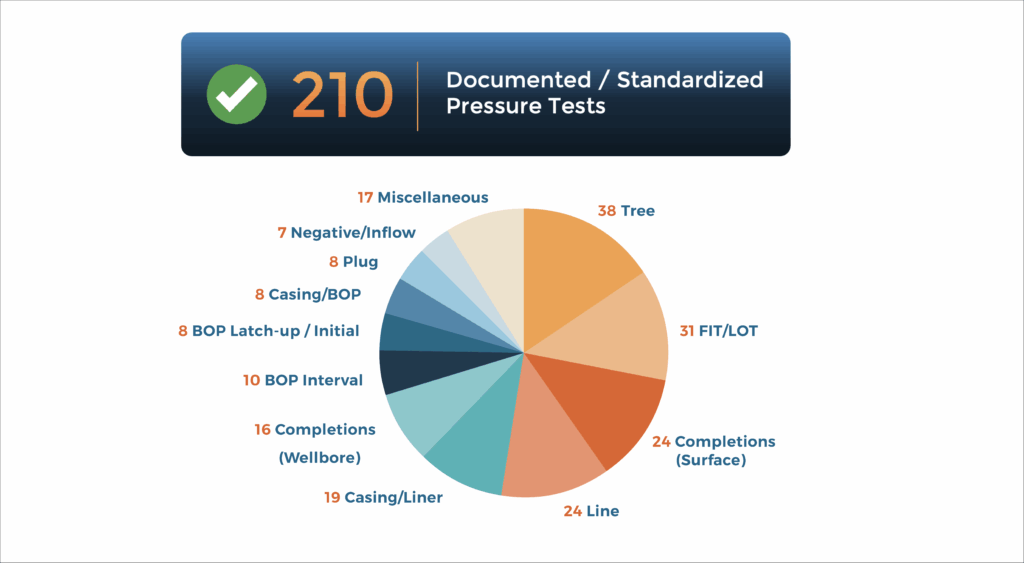
Figure 2. Breakdown of 210 documented pressure tests across the drilling and completion lifecycle, illustrating range of tests captured in standardized reports.
All tests were documented in easy-to-audit reports, ensuring compliance and transparency. While the time savings highlighted here focuses on BOP digital pressure testing, the campaign included 210 documented pressure tests covering the full cycle of drilling and completing these wells.
Importantly, IPT Global’s field coaches were removed from the rig after initial training, with the offshore crew fully supported remotely by our 24-7 Real-Time Operations Center (RTOC). This demonstrated that solution adoption and consistent high performance were embedded in the crew and sustained throughout the campaign.
IPT Global provides confidence in every test for every well by applying stringent in-house criteria, delivering faster results than traditional methods, and working collaboratively with customers to drive operational safety and efficiency. Our software ensures information flows seamlessly to the right people at the right time, while WellSchematic and BarrierManagement allow safe planning and execution ahead of operations. All of this is supported by real-time oversight from our RTOC.
Looking ahead, IPT Global will continue to advance well assurance intelligence and software integrations to make our solutions even more accessible and valuable for end users.