

Most digital pressure testing applications on the market regularly pass leaks due to a lack of advanced data analysis. Operators and contractors should be concerned that digital solutions use standard decline analysis to validate high-pressure tests on critical rig equipment and do not account for thermal effects.
The lack of accurate leak detection on blowout preventers (BOPs), production trees, and well barrier elements increases the risk of process safety incidents, which puts operations at risk of harm to the environment, people, and assets because of increased risk of process safety incidents due to lack of leak-detection on BOPs, production trees and well barrier elements.
Many digital pressure testing alternatives falsely claim to be predictive by using a curve extrapolation for pressure decline analysis. There is no truly predictive product on the market that utilizes machine learning and artificial intelligence.
However, one digital pressure testing solution using advanced analysis algorithms has transformed one of the industry’s most consequential assurance activities.
This case study shows how IPT Global’s SureTec® PressureTesting solution, using algorithms, developed with the world’s largest pressure testing database, detected potential leaks that were missed by a competing digital pressure testing vendor for two high-pressure tests. Importantly these tests were during live operations offshore.
Digital Competitor Misses Leaks on Critical Equipment Tests
Decline analysis uses a percentage of the required test pressure as the criteria to determine the allowable pressure drop over a given period (typically 5 minutes). For example, if a system has a test pressure of 10,000 psi and the vendor selects 0.5% as the Decline criteria, then the acceptable pressure loss is calculated as follows:
Acceptable Pressure Loss = (Criteria x Test Pressure) = 0.005 x 10,000 psi = 50 psi
The same decline criteria and required test pressure were used in high-pressure tests on a cement unit and a low torque valve shown in Figures 1 and 2, respectively. During the tests, two data points (A and B) were selected five minutes apart by the competitor software. Using the above decline criteria, both tests passed because the respective pressure losses of 49 psi and 48 psi were less than 50 psi.
Using decline criteria alone to validate critical components ignores the thermal effects of pressurization on the system. Pressurization increases the temperature of the system, and the pressure decreases when the system cools during shut in.
It’s the same effect that occurs when car tires lose pressure in the winter. As a result, when the system is shut in to monitor the pressure, part of the pressure drop is due to cooling of the test fluid as the system loses heat to the surroundings. Because of its simplicity, standard digital testing utilizing decline analysis cannot distinguish between pressure loss due to thermal effects and pressure loss due to a potential leak.
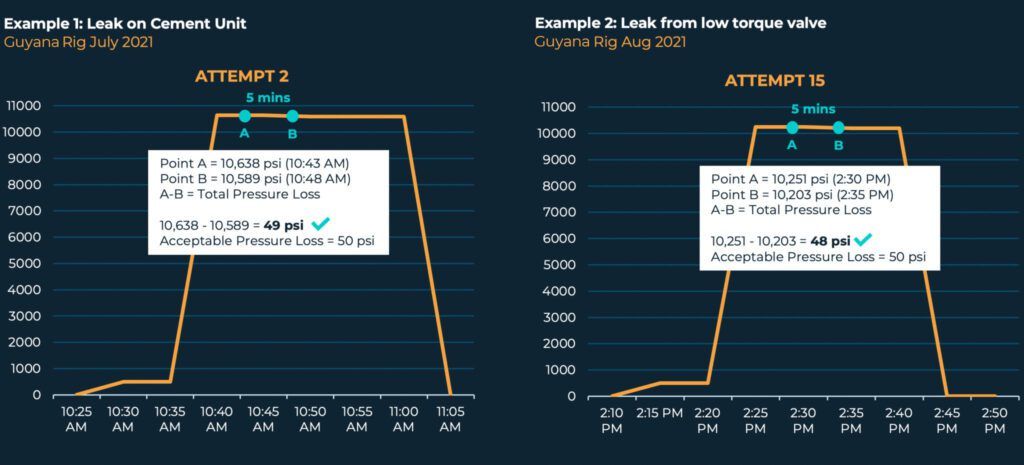
Example 1 – Example of competitor digital solution passing a test with pressure loss of 49 psi. This large pressure drop was allowed due to a lack of advanced algorithms, only available through IPT Global’s PressureTesting. PressureTesting removed the thermal influence and identified a leak on the cement unit.
Example 2 – Example of a competitor digital solution passing a test with a pressure loss of 48 psi. This large pressure drop was allowed due to a lack of advanced algorithms, only available through IPT Global’s SureTec PressureTesting solution. PressureTesting removed the thermal influence and identified a leak on the lower torque valve.
IPT’s Advanced Analysis Algorithms Considers the Thermal Effects of Pressurization
To demonstrate that competing digital approaches are inadequate for leak detection, the same tests were analyzed using Global’s PressureTesting solution with a field-tested physics-based advanced analysis. This analysis uses strict criteria to detect a leak with a high level of confidence.
The IPT Global analysis failed the same tests that passed using a competing digital solution. IPT Global technology was able to differentiate thermal influences as the test fluid cooled off during testing.
IPT Providing Leak Detection Assurance
Accurate leak detection depends on testing methods that go beyond simple curve extrapolation. IPT Global’s PressureTesting solution applies physics-based layered algorithm validation, to confirm the integrity of critical equipment and well barrier elements with objective, repeatable results.
Contact us to learn how PressureTesting’s leak detection capabilities can support your operations.