

A single event involving the malfunction or failure of a blowout preventer (BOP) component on a drilling rig can result in unplanned downtime, costing millions of dollars. These events can add up throughout the equipment’s lifecycle to a significant amount of cost and lost time. Due to uncertainty about the lifecycle of BOP stack components, drilling contractors may arbitrarily replace components during scheduled maintenance to try to mitigate unplanned downtime.
Additionally, history has shown that a malfunctioning BOP component can result in a loss of well control, threatening the safety of people, assets, and the environment. Because of the significant safety risks, the Bureau of Safety and Environmental Enforcement (BSEE) established regulations that require operators to use real-time monitoring (RTM) on subsea BOPs, surface BOPs on floating facilities, and wells in high-pressure, high-temperature environments.
This article describes how IPT Global’s SureTec® Equipment Health Monitoring solution helped a customer identify a malfunctioning BOP control system component so it could be replaced during scheduled maintenance, before it caused an interruption in drilling operations or a loss of well control. It also outlines the BSEE real-time monitoring requirements that apply to these operations.
How Real-Time Monitoring Supports Condition-Based BOP Maintenance
IPT Global provides full monitoring services of well control equipment (WCE) and downhole drilling data. For BOPs, this work runs on the SureTec Equipment Health Monitoring solution, which pairs continuous equipment data with review by IPT Global’s BOP analysts. The solution includes four modules: Monitoring for real-time tracking of BOP control system data, HealthAnalytics for trend analysis that supports maintenance planning, FaultTree for fault tree analysis of BOP functions, and ComplianceReady for documenting regulatory compliance.
This combined approach of monitoring plus advanced data analytics elevates the maintenance program from schedule-based to condition-based, improving efficiency and reducing risk.
Historically, failures have driven BOP maintenance response. Equipment Health Monitoring shifts that approach from reactive to proactive. Real-time alarms and alerts show teams how equipment is performing, so they can address problems before a failure happens.
Case Study: Catching a Failing Regulator on a Gulf of America Jack-Up Rig
In early 2022, an IPT Global BOP analyst was using Equipment Health Monitoring to track the condition of a surface BOP control system on a jack-up rig in the Gulf of America. The experienced and trained analyst was able to identify a possible failure ahead of an event, ensuring the rig avoided unplanned downtime.
In this example, the issue was with the BOP manifold regulator, which was supplied with 3,000 psi from the accumulator bank. The manifold regulator reduces the supply pressure to 1,500 psi for operation of the BOP pipe rams, blind shear rams (BSRs), and choke and kill valves. While monitoring the accumulator, the BOP analyst noticed that the manifold regulator showed an increased leak-off rate after the BSRs were functioned closed (see graph below). In this case, the 1,500 psi manifold regulator pressure was deviating by more than 25 percent. Although it is not uncommon for a regulator’s pressure to vary, the BOP analyst knew that the level of deviation likely indicated an imminent component failure or a leak in the hydraulic circuit.
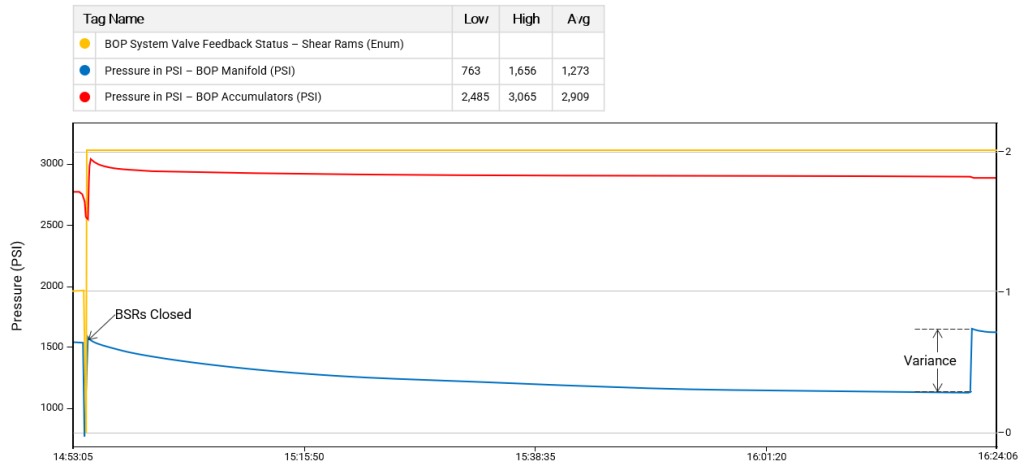
After our BOP analyst logged the event, the customer was notified of anomalous regulator behavior. When IPT Global provided comparative trends from other regulators, the drilling supervisor determined that the regulator should be replaced during scheduled maintenance to avoid disrupting future drilling operations.
The customer replaced the regulator before commencing drilling operations on a sister well. Subsequent BOP monitoring showed that the new regulator was operating normally. Notably, the customer also provided the new regulator’s certification for documentation in IPT Global’s database for future lifecycle tracking.
The Result: Planned Replacement Instead of Unplanned Downtime
IPT Global’s Equipment Health Monitoring solution and the customer’s proactiveness to replace the manifold regulator potentially avoided a very expensive BOP failure during drilling operations, as well as reduced risk to personnel and the environment. The outcome also shows how drilling contractors can reduce expenses by focusing on components that need to be replaced during scheduled maintenance rather than arbitrarily replacing components.
BSEE Real-Time Monitoring Requirements Under 30 CFR 250.724
The BSEE Code of Federal Regulations (CFR) requires operators to provide real-time monitoring (RTM) for BOPs in the Gulf of America. BSEE CFR Chapter II – Subchapter B – §250.724 (a) describes the RTM requirements as follows.
§ 250.724 What are the real-time monitoring requirements?
(a) When conducting well operations with a subsea BOP or with a surface BOP on a floating facility, or when operating in a high-pressure, high-temperature (HPHT) environment, you must gather and monitor real-time well data using an independent, automatic, and continuous monitoring system capable of recording, storing, and transmitting data regarding the following:
(1) The BOP control system;
(2) The well’s active fluid circulating system; and
(3) The well’s downhole conditions with the bottom hole assembly tools (if any tools are installed).
Talk to IPT Global About BOP Monitoring
SureTec Equipment Health Monitoring gives operators and drilling contractors a clearer view of how critical BOP components perform over their lifecycle. With that information, teams can plan maintenance around actual equipment condition, replace components when the data shows a need, and reduce the risk of unplanned downtime. To learn how Equipment Health Monitoring can support your BOP maintenance program, contact our team.