
Managed Pressure Drilling (MPD) is an advanced drilling technique that uses a closed-loop circulation system for more accurate bottom hole pressure control, resulting in higher drilling efficiency and the prevention of drilling hazards. To ensure the benefits of managed pressure drilling are realized, more operators are turning to IPT Global to validate the integrity of critical equipment, reducing non-productive time (NPT) and safety risk in the process.
How is the Well Controlled in Conventional Drilling?
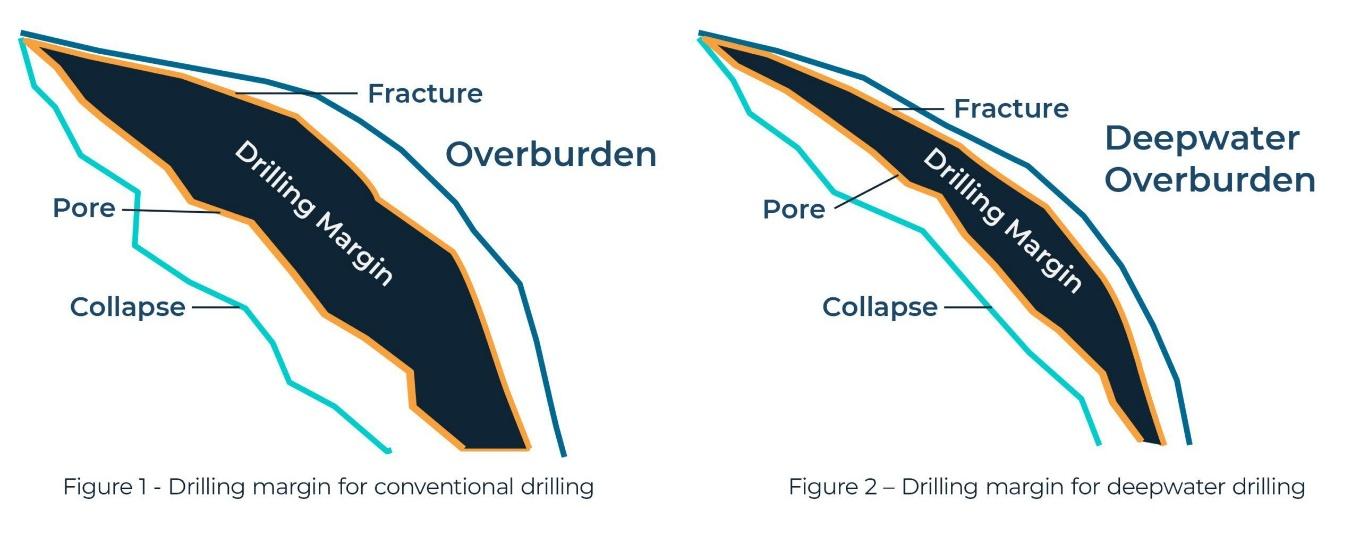
In conventional (onshore) drilling, the circulating system operates in a flow path that is open to the atmosphere. To control the well, drilling engineers adjust the mud density and may also use the equivalent circulating density (ECD) to maintain the bottom hole pressure (BHP) within a drilling margin determined by the formation’s pore pressure and fracture pressure (Figure 1). After the mud exits the top of the wellbore, it goes through a flowline to mud-gas separation and solids control equipment before being recirculated into the well. When the pumps are circulating mud in the hole, the bottom hole pressure is a function of the hydrostatic pressure plus the annular friction pressure of the mud. When the pumps are turned off to make connections, the bottom hole pressure is controlled solely by the hydrostatic pressure of the mud in the hole.
Conventional Drilling Challenges
Drilling using an open circulating system presents challenges to control bottom hole pressure in deep wells. First, small changes in mud density have a large impact on the hydrostatic pressure. Also, deep wells have high annular friction losses, resulting in large changes in bottom hole pressure when the pumps are turned off. If the bottom hole pressure becomes greater than the hydrostatic pressure of the mud, an influx of formation fluids can create a kick. The driller tries to control a kick by adjusting the mud density and shutting in the well to monitor the pressure. Then the driller circulates the kick out of the hole at a slow pump rate. The repeated cycles to kill the well and circulate out the kick significantly increases NPT and safety risks.
Drilling margins are narrower in deepwater where the overburden pressure of seawater is less than that of rock and the formation strength is lower (Figure 2). As a result, it is standard practice in deepwater operations to set numerous casing strings at shallow depths to avoid extensive lost circulation.
Why More Operators Are Using Managed Pressure Drilling
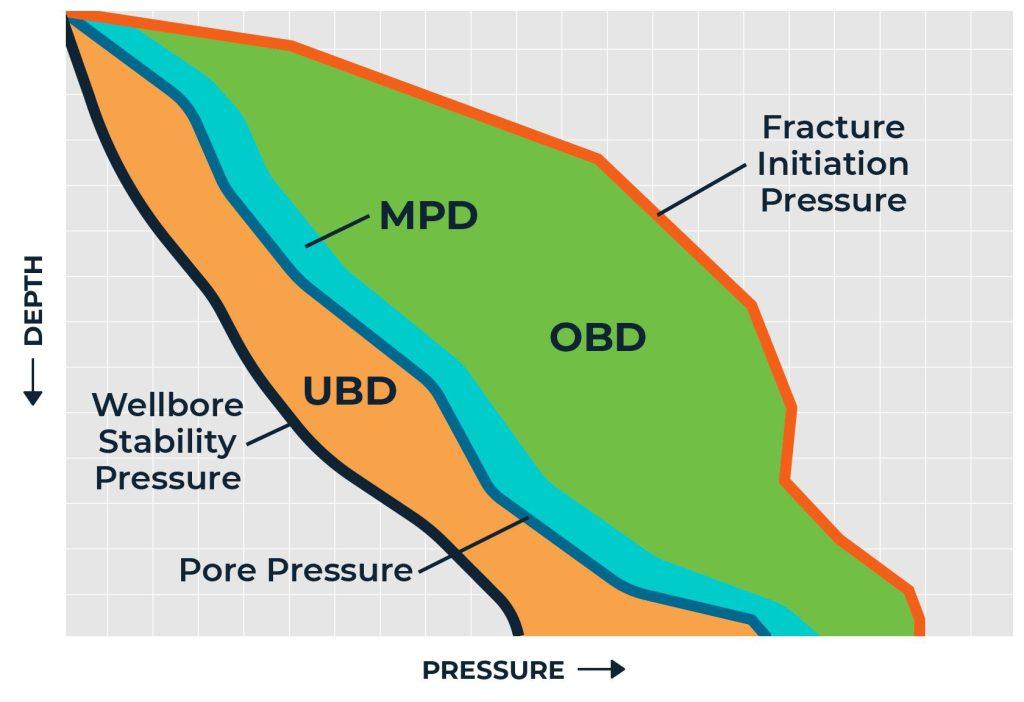
Managed Pressure Drilling (MPD) is a closed circulation system that allows drillers to monitor the wellbore’s annular hydraulic pressure profile more accurately and react in real time to precisely control bottom hole pressure. The annular hydraulic pressure is maintained slightly above the pore pressure to prevent the influx of formation fluids, and well below the fracture pressure to avoid loss of circulation. Preventing these hazards improves safety and greatly reduces NPT in complex wells by increasing operational drilling efficiencies. MPD makes access to older, depleted reservoirs possible and allows operators to drill previously “undrillable” wells. MPD can also reduce the number of casing strings required, thereby reducing trips and saving time, in addition to allowing a well to be completed in a larger hole size.
How IPT Global Adds Value to Managed Pressure Drilling
IPT Global provides the highest level of MPD component integrity assurance, pairing our experienced industry experts with SureTec®, our software platform that connects well design, barrier management, pressure testing, equipment health monitoring, and compliance activities into a continuous assurance workflow.
Collaboration with Managed Pressure Drilling Stakeholders
IPT Global works closely with operators, rig contractors, and MPD contractors to develop strategies that optimize test planning and execution. Typically, MPD component validation can be accomplished with relatively few additional tests during commissioning and BOP testing. Through our PressureTesting solution, IPT Global ensures that the required number, frequency, and types of tests are run to validate component integrity, avoid equipment-related NPT, and comply with local regulatory bodies.
Simplified Schematics and Test Planning
The SureTec platform allows existing BOP schematics to be used or modified for MPD test plans. SureTec’s WellSchematic and Equipment Health Monitoring solutions validate all connections and component names, making it easier to detect and correct errors compared to using complex rig piping and instrumentation diagrams (P&IDs). PressureTesting’s TestPlanner module clearly identifies the test criteria, valve alignment, pressure path, and MPD components that will be validated in each test step.
Increased Test Efficiency and Integrity Testing
IPT Global’s SureTec solutions use advanced proprietary algorithms and stringent criteria capable of validating MPD component integrity at low pressure to significantly reduce pressurized time and increase integrity assurance.
Comprehensive Digital Reports and Analytics
All SureTec solutions also generate standardized, detailed planning and test reports with complete documentation, including test steps, pressure graphs, analysis charts, schematics, and tested components. IPT Global’s Cloud-based platform lets organizations archive, retrieve, and analyze tests to share best practices and drive performance across teams.
Ready to Optimize Your MPD Program?
Talk to our team to see how SureTec can cut pressurized test time, reduce non-productive time, and give you the component integrity assurance your MPD program depends on.