
In offshore drilling, BOP testing is a critical component of well barrier assurance. However, inconsistent processes across rigs can lead to incorrect line-ups, missed tests, and operational risk. This case study examines how the IPT Global Service Delivery Team supported an operator to improve BOP testing performance across a five-rig fleet in the Gulf of Mexico using SureTec® PressureTesting.
Across a five-rig fleet operating in the Gulf of America, incorrect line-ups (sometimes known as misalignments) during BOP tests occurred up to 60% of the time. The potential of executing BOP pressure tests with these errors increased safety risk and decreased operational efficiencies. The difference across rigs wasn’t equipment or operator. It was the consistency of the application of the well barrier assurance testing process by rig crews. The operator requested IPT Global’s support across the fleet to ensure a common baseline performance level was maintained across the rigs.
In offshore drilling operations, performance gaps between similar rigs working together with the same operator are common. Crew experience, familiarity with procedures, and operational maturity all vary. What doesn’t vary, however, is the consequence of a missed well barrier test. Incorrect line-ups undetected during BOP testing can leave critical components untested, create regulatory and environmental exposure, and compound into costly rig downtime.
To help establish a standardized approach, the IPT Global Real-Time Operations Center (RTOC) conducted a fleet-wide analysis of all BOP pressure tests over the course of one year. The results illustrate both the scale of the problem and the value of a consistent, technology-backed assurance framework, regardless of individual rig performance.
A fleet-wide analysis of 76 BOP pressure tests highlights both the scale of incorrect line-ups and the impact on offshore drilling performance.
When results are broken down by rig, the variance is stark and highlights a critical point: performance is driven by the consistent application of robust processes and assurance.
| Rig | No. of BOP Tests | Tests with Incorrect Line-ups | Missed Incorrect Line-ups Detected by RTOC | Lost Time (min) |
| Rig A | 17 | 59% | 5 tests (29%) | 270 |
| Rig B | 18 | 56% | 3 tests (17%) | 165 |
| Rig C | 8 | 13% | — | 5 |
| Rig D | 20 | 5% | — | 8 |
| Rig E | 13 | 0% | — | 0 |
The rigs with the lowest incorrect line-up rates share a common thread: a standardized, familiar process developed or supported by the IPT Global Service Delivery Team. Rig C operates with a full-time IPT Global Field Advisor supporting BOP testing execution and well barrier assurance processes embedded with the crew. The one incorrect line-up it recorded during the year was caught immediately by that IPT Global team member. Rig D had IPT Global Field Advisors on location for an extended period who helped build simplified, consistent test plans; the crew became deeply familiar with those plans, and the data reflects it. Rig E recorded zero incorrect line-ups across all 13 tests.
Rigs A and B tell a different story. Rig A recorded a total of 15 incorrect line-ups during BOP testing operations. This was the highest in the fleet and impacted 59% of its BOP tests, with the frequency trending upward as the year progressed. Rig A’s crew had recently been blended from two different drilling contractors, introducing unfamiliarity. IPT Global Field Advisors were not present onboard for BOP testing, though the IPT Global Service Delivery Team remotely identified five incorrect line-ups that were undetected by rig personnel. This accounted for three and a half hours of intervention time that would otherwise have resulted in undetected deviations.
Rig B showed a persistent failure at a specific test step with incorrect line-ups occurring in 56% of all tests, traceable to an incorrect cementer line-up that went uncorrected over multiple test cycles.
This is not a story about which rigs have better crews or stronger safety cultures. It is a demonstration of what happens when a standardized well barrier assurance and BOP testing process is applied consistently across a fleet, and what happens when it isn’t.
Every rig has its own dynamics: crew experience, contractor mix, familiarity with test plans, and operational culture and tempo. IPT Global does not override these dynamics. Instead, the SureTec PressureTesting software provides a standardized well barrier assurance framework for BOP testing, combining real-time monitoring, structured verification processes, and field expertise that operates independently of them.
Where a rig is already performing well, this approach reinforces and documents the behavior. Where performance is inconsistent, it identifies deviations early, before they become compliance events, safety incidents, or compounding downtime.
The data makes this clear. The eight incorrect line-ups missed by onboard crew but detected through real-time monitoring and structured BOP testing verification via PressureTesting and the IPT Global RTOC were identified through a consistent, structured process combining volume benchmarking, step-by-step checklist verification, and direct communication protocols, applied consistently and independently of rig floor activity.
Operators managing multiple assets simultaneously in offshore drilling operations face these same challenges at a larger scale. Performance varies, crews turn over, and experience levels differ. While a fleet-wide assurance program like SureTec PressureTesting does not remove these variables, it does establish a consistent baseline, ensuring performance gaps do not go undetected.
The rigs that performed best were not immune to incorrect line-ups. They were simply better equipped through familiarity, simplified plans, and consistent oversight to prevent or catch them early. IPT Global’s role is to extend that level of performance across the entire fleet, not just to those that have benefited from time and continuity.
A standardized approach to well barrier assurance is not a substitute for good rig culture. It is the mechanism that ensures good practice is applied consistently, regardless of where any individual rig sits on the performance curve.
Looking to improve BOP testing performance or strengthen your well barrier assurance processes? Contact IPT Global to implement a standardized, pressure testing and real-time monitoring framework across your offshore drilling fleet.
When the operator introduced a new rig into the region, they quickly identified a performance gap in Blowout Preventer (BOP) testing. Rigs with several years of experience using IPT Global’s SureTec® PressureTesting solution consistently delivered faster and more reliable results. The new rig had not yet adopted the standardized digital pressure testing workflow required to achieve comparable performance.
The operator’s objective was to bring the new rig up to mature BOP testing performance as quickly as possible while maintaining verifiable well barrier integrity. Achieving this required shifting from variable manual processes to a consistent, documented digital pressure testing approach that reduced risk, minimized inefficiencies, and supported better operational decisions across the fleet.
IPT Global partnered with the operator to implement its PressureTesting solution, provide hands-on coaching, and establish standardized workflows. The result was a rapid improvement in safety and efficiency, with 210 documented pressure tests over the course of 14 months and significant reductions in critical path time early in the campaign.
Each well is unique, making direct comparisons in well barrier testing difficult. BOP testing provided the most practical benchmark because of its central role in safety and operational efficiency. The operator sought two outcomes: absolute confidence in barrier integrity and a reduction in high-pressure test times to minimize operational exposure and risk.
In addition, they wanted a consistent, documented pressure testing practice across the fleet, along with improved transparency between onshore support engineers and offshore execution teams. This was essential to minimize invisible lost communication time during a compressed drilling program.
IPT Global’s leading digital pressure testing software delivers accuracy, efficiency, and consistent assurance across every pressure test.
Adopting new technology requires the right expertise and support. IPT Global ensures customers maximize the value of our solutions through a unique blend of operational experience and data science. Our team combines direct rig experience with specialized software and analytics knowledge, applying technical excellence with practical execution.
IPT Global deployed field coaches to train crews in real operating conditions and ensure consistent, effective use of the software. Once training was complete, our 24/7 Real-Time Operations Center (RTOC) provided continuous support for planning, execution and oversight. IPT Global also supported the operator by embedding advisors within the wells team and providing real-time visibility across rigs, shore bases, and headquarters.
A key component of the solution was IPT Global’s PressureTesting TestPlanner module – a verification matrix developed alongside drilling engineers as they designed the test plan. TestPlanner provides assurance that every valve and component is tested to the correct pressure. Presented in a clear matrix format, it enables easy identification of optimization opportunities, such as removing unnecessary test steps and ensuring each barrier element is tested in the most efficient sequence.
All 210 pressure tests executed through the wells campaign were documented in standardized format, inclusive of all formation integrity tests (FIT) / Leak off tests (LOT), BOP tests, inflow tests, and completions testing.
Within the PressureTesting solution, pressure data can be captured from existing infrastructure such as cement units, IWOCS, or ROV systems and automatically integrated into the SureTec platform. The PressureTesting DigitalApprovals module removes the inefficiencies of chasing post-test wet signatures or waiting for email confirmations. Our RemoteView module bridges the gap between offshore execution and onshore approval, giving onshore teams real-time transparency into critical wellbore barrier verification. And with the ComplianceReporting module, each test is compiled into an auditable documentation report that can be shared with regulators and incorporated into end-of-well reporting.
A function that sets IPT Global’s SureTec platform apart is its WellSchematic solution, which provides the ability to generate wellbore and barrier schematics, providing offshore teams with clear, visual representations of the well configuration. For years, describing well configurations relied on complex plans and written instructions. IPT Global streamlines this by automatically importing data from industry-standard well planning software and offering drag-and-drop options. Through the BarrierManagement module, primary and secondary barriers can be assigned, making it easy to visualize which barrier envelope is being tested at each stage, reducing confusion and enhancing operational efficiency offshore.

Figure 1. Reduction in total BOP test duration across the campaign, from 14 hours to six hours achieved early and sustained through subsequent tests.
The most significant achievement was the reduction of the overall BOP test sequence from approximately 14 hours to just six hours, and this was achieved after only three BOP tests out of the 14 completed during the campaign. These improvements were driven by a combination of IPT Global’s technology, coaching, and the visual clarity provided by our software solutions.
At the core of this success was our Thermally Compensated Leak Detection, which reduced individual BOP test steps from 17 minutes to eight minutes, delivering more than a 50 percent saving per step. These gains were further supported by TestPlanner, which optimized test planning through our verification matrix, WellSchematic, and BarrierManagement, as well as efficiency improvements achieved through crew training and real-time operational support.
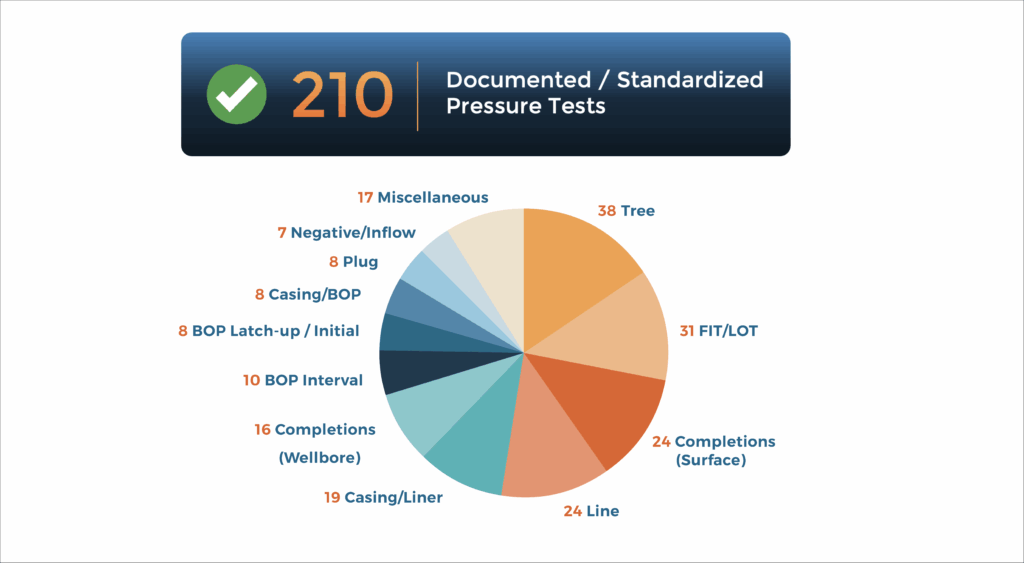
Figure 2. Breakdown of 210 documented pressure tests across the drilling and completion lifecycle, illustrating range of tests captured in standardized reports.
All tests were documented in easy-to-audit reports, ensuring compliance and transparency. While the time savings highlighted here focuses on BOP digital pressure testing, the campaign included 210 documented pressure tests covering the full cycle of drilling and completing these wells.
Importantly, IPT Global’s field coaches were removed from the rig after initial training, with the offshore crew fully supported remotely by our 24-7 Real-Time Operations Center (RTOC). This demonstrated that solution adoption and consistent high performance were embedded in the crew and sustained throughout the campaign.
IPT Global provides confidence in every test for every well by applying stringent in-house criteria, delivering faster results than traditional methods, and working collaboratively with customers to drive operational safety and efficiency. Our software ensures information flows seamlessly to the right people at the right time, while WellSchematic and BarrierManagement allow safe planning and execution ahead of operations. All of this is supported by real-time oversight from our RTOC.
Looking ahead, IPT Global will continue to advance well assurance intelligence and software integrations to make our solutions even more accessible and valuable for end users.
IPT Global’s SureTec PressureTesting solution is, the leading software for digital pressure testing and integrity assurance throughout the well’s lifecycle. From pre-deployment to P&A, PressureTesting enables procedural compliance with easy-to-use modules for designing, planning, testing, and reporting to drive higher levels of operational performance, assurance, and safety. PressureTesting is the only tool on the market where all relevant workflows are part of one seamless application to ensure the highest levels of performance, transparency, and compliance.
SureTec PressureTesting TestPlanner and WellSchematic modules provides interactive schematic builders to properly depict the design and layout of the blowout preventer (BOP), production trees, manifold, and wellbore. Once the schematics are built, test plans are made to comply with required acceptance criteria and process standards.
The SureTec PressureTesting solution can be utilized for all aspects of pressure testing, including integrity- critical equipment and well barrier elements. Examples of testing include: BOP testing, casing tests, well barrier elements, and completions, production, intervention, and plug and abandon tests.
Planning tests accurately without the proper tools can result in errors and omissions unless time-consuming checks and reviews are performed. Even after review, many plans often change somewhat at testing time, which makes assuring all components are tested properly very difficult. Through its TestEngine and TestPlanner modules, PressureTesting offers its provides an exclusive dynamic coverage capability and pressure path visualizations that ensure all required components are tested to the proper pressure and configuration. This coverage capability allows the user to easily assign which sides of valves and which components are to be tested to certain pressures and confirms that all will be tested properly prior to pressure testing. Dynamic coverage tracking allows test plans to be modified at test time and automatically communicates coverage status and alerts. This further ensures all required components and barriers are properly validated even when test plans must adapt to changing conditions.
For further assurance, PressureTesting’s DigitalApprovals module works in conjunction with TestEngine and TestPlanner, providing cloud-based collaboration, version control, review and approval, and fully auditable records of activity. This eliminates the need to email spreadsheets and other documentation back and forth, ensuring streamlined communications.
The SureTec PressureTesting solution validates the integrity of critical well control equipment and well barrier elements through multi-dimensional layered algorithms. These algorithms provide objective pass/fail test results
Decline Analysis is the industry standard test validation method that was originally derived from circular chart recorders (CCRs). Basic digital alternatives to the CCRs utilize decline analysis and often tout it as being predictive, based on simple curve extrapolation. IPT Global recognized this as a major assurance opportunity and sought to develop algorithms that provide higher assurance and efficiency to test validation.
IPT Global leads the industry in advanced analytics and has developed additional algorithms to validate tests, based on an extensive test database. IPT Global’s proprietary algorithms allow us to push past industry standards for more assurance. These additional analyses add extra layers of validation, which improves accuracy and efficiency. Moreover, our algorithms offers critical time savings with each test potentially passing in as fast as seven minutes. From 2015 to 2022, TCLD has saved our customers over 11,000 hours of rig time. For increased assurance, IPT Global’s Trend Analysis can be used with any testing criteria to confirm the pressure ROC is continuously improving. SureTec PressureTesting can also simultaneously test casing with the BOP for additional time savings.
IPT Global’s testing algorithms provide the highest levels of efficiency and assurance to ensure well integrity. Our Inflow Testing criteria offers unmatched assurance by removing subjectivity in test interpretation. IPT Global also has developed the ability to execute up to four tests simultaneously. This capability is critical for high volume testing operations, such as during completions.
The PressureTesting modules Compliance Reporting and Performance Reporting generates test reports with all relevant information to the operation. Another PressureTesting exclusive requires any failed test attempts be fully documented for full transparency and to avoid unnecessary regulatory non-conformance. All reports are stored in the Cloud for easy access to relevant personnel. With comprehensive yet clear test results, these reports are essential in improving communications during operations and handover, as well as useful for regulatory bodies and any internal or external audits.
SureTec PressureTesting brings digital pressure testing, Cloud access, and IPT Global’s together in one solution, including multi-testing and inflow testing capabilities. Contact us today to learn how IPT Global can help solve your pressure testing needs.