
Well barriers consist of one or more well barrier elements (WBEs), and the failure of a single WBE can cause the well barrier to fail. When well integrity is compromised by the failure of a well barrier, it can result in loss of production and harm to people, the environment, assets, and the operator’s reputation.
The lack of validation criteria and the subjective interpretation of test results for critical WBEs are root causes of well integrity issues in the oil and gas industry. Addressing those root causes starts with how WBEs are tested and validated. IPT Global’s SureTec® PressureTesting solution uses proprietary algorithms and strict validation criteria to remove subjectivity from WBE testing and reduce pressurized time, saving rig time and lowering risks.
Where Circular Chart Recorders Fall Short
Many operators still verify well barrier integrity with circular chart recorders (CCRs). A BSEE report identified several problems with this approach, including:
- Handwritten notes placed on the circular chart can lead to a lot of data manipulation and mistakes during the recording of the tests
- It’s hard to keep track and document the tests on all the different valves
- Most leaks happen in low pressure tests and the clarity of the pressures on the chart recorder is not clear in the low ranges
- The testing procedure is not consistent between different rigs, as offshore personnel have their own way of documenting and determining the criteria of pass and failure of the tests
- Any testing plan changes are hard to manage and track
- There are no standards for component or pressure path representation
- Pressure path analysis is done manually
Advantages of Going Digital with SureTec Pressure Testing
SureTec PressureTesting addresses these issues highlighted in the BSEE Report with objective validation criteria, less pressurized time, and complete test documentation. For a closer look at how the two approaches compare in the field, see From Circular Chart Recorders to Digital Pressure Testing, which covers a four-rig operator trial.
There are four areas where converting to digital pressure testing can have a significantly positive impact on operations including:
Increased Accuracy and Objectivity
Digital validation with SureTec is more accurate than CCRs and uses transparent and objective criteria for validating pressure tests. SureTec uses physics-based algorithms to provide enhanced analysis for the most rigorous and effective testing in the industry. Our algorithms use transparent criteria that has been validated against an expansive database of over 100,000’s of pressure tests. The subjective interpretation of CCR tests is prone to human error.
Greater Efficiency & Safety
SureTec provides a 30% reduction in test time versus CCRs by eliminating subjectivity and unnecessary pressurized time. Due to the accuracy of the testing with SureTec, the need to retest is eliminated. This improves safety by removing unnecessary pressurized time, which puts people, the environment, assets, and reputation at risk.
Better Documentation and Data Utilization
SureTec provides comprehensive test reports to assure reliable handover with complete documentation. SureTec consists of tools that allow users to create custom schematics, visualize pressure paths, and compare tests. Tests can be overlayed to show rate of change differences, pressure paths, and barriers throughout each step of a well’s lifecycle.
Reduced Costs
SureTec reduces costs by decreasing test time and increasing accuracy. This lowers risks, workforce hours, transportation, expenses from incidents, and reputation devaluation.
Going digital is only part of the picture, though. The analysis method behind the data matters just as much.
The Limits of Percent Decline Analysis
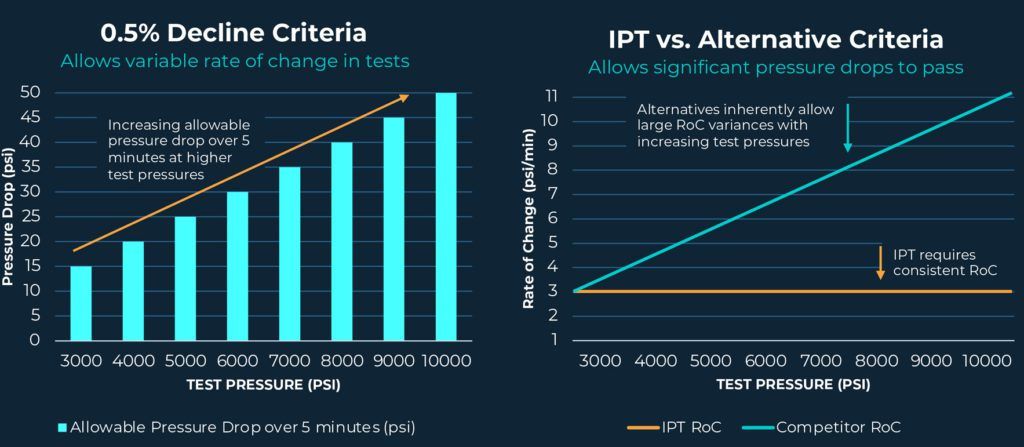
Percent decline analysis is the minimum requirement set by industry regulators and is used by some pressure testing technology companies. It’s a simple calculation that divides the system pressure drop by a fixed time interval (e.g., 30 minutes). Because the validation criteria are based on a percentage of required test pressure, the allowable pressure drop changes with the test pressure. As a result, percent decline can’t consistently detect a leak or differentiate between a leak and thermal effects on the test fluid.
Standard Decline Analysis Is Insufficient
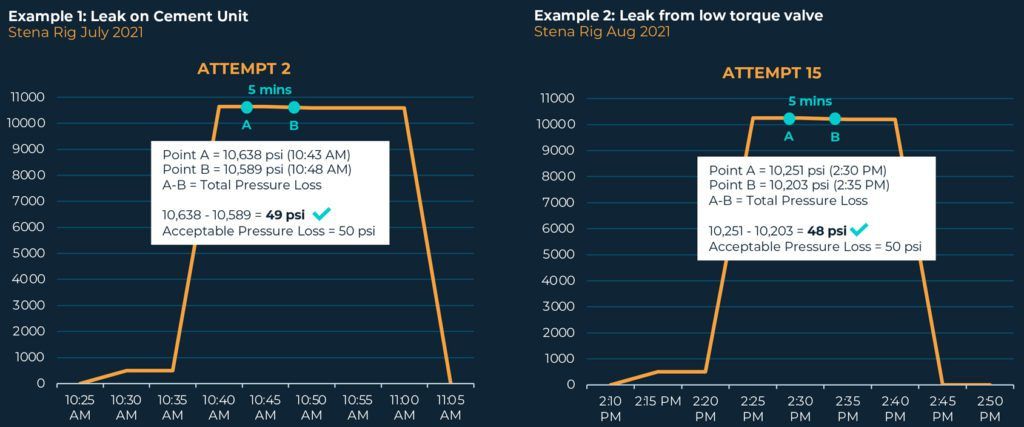
Decline Analysis Passes Leaks
How SureTec PressureTesting Goes Beyond Percent Decline Analysis
IPT Global’s SureTec PressureTesting solution goes beyond percent decline analysis with its advanced physics-based algorithms and multi-dimensional verification. Each algorithm adds a layer of verification that percent decline analysis can’t provide on its own. In fact, of the digital pressure testing methods available, percent decline analysis offers the lowest level of integrity assurance, so it should not be used alone to validate WBE integrity.
To see how these methods work in more detail, request our white paper, Advanced Well Integrity Management With SureTec, or contact IPT Global to talk through how SureTec PressureTesting could fit your well barrier testing program.