
In a controlled offshore field trial, a major operator evaluated two competing approaches to BOP pressure testing and well barrier verification on sister drillships in the Gulf of America. The objective: determine which solution delivered faster, more accurate validation of well control equipment performance.
Traditional predictive analysis methods, commonly used in pressure decline analysis, rely on assumed coefficients rather than actual test data. This introduces uncertainty in well barrier testing, especially in complex subsea environments.
Operators required a solution that could:
IPT Global deployed its SureTec® PressureTesting solution, a digital pressure testing software with a patented advanced analysis engine that leverages thermally compensated leak detection (TCLD).
Unlike conventional methods, TCLD:
This approach aligns with modern barrier management software strategies and supports BOP real-time monitoring across offshore operations.
Field trial results confirmed a clear performance advantage:
The operator concluded that SureTec PressureTesting provided superior efficiency and assurance in subsea BOP testing and overall well control equipment performance. This resulted in the operator changing their digital pressure testing provider from a competing company to IPT Global across all offshore operations.
As the oil and gas industry moves toward digital transformation, relying on assumption-based models is no longer sufficient. Advanced analytics provided through IPT Global’s SureTec platform deliver:
For operators seeking to optimize bop testing, well barrier element pressure tests, and negative pressure testing (inflow testing), adopting real-time, data-driven analysis is critical. Predictive models estimate. IPT Global validates. Contact us to learn how we can help optimize your operations.
Some digital pressure testing methods used in the oil and gas (O&G) industry rely on predictive early data trends to draw conclusions about future performance. While these approaches may appear sophisticated, they often depend on assumptions that can be misleading. In safety-critical operations, the consequences of being wrong can be very dangerous.
At IPT Global, our approach is grounded in physics: how equipment actually behaves under pressure and an array of thermal variables. Our SureTec® PressureTesting solution focuses on measurable system behavior rather than early-time trends and predictions, which provides greater assurance, protecting people, assets, and the environment.
During well control equipment pressure testing, a pressure decline can result from three distinct causes:
Why is this a problem? Because all three occur at the same time, and their combined effects appear as a single pressure curve making interpretation more challenging than it first appears.
Many digital pressure testing tools attempt to determine a pass or fail by observing how pressure decline slows over time. However, thermal and elastic effects naturally dominate early behavior and always attenuate. This early stabilization can create the appearance of improvement even when a real leak is present.
In short, early-time prediction alone does not confirm integrity, but rather introduces uncertainty at precisely the point where certainty is required.
Rather than predicting what might happen, IPT Global’s PressureTesting solution models how a leak-free system should behave. We account for normal pressure changes caused by temperature and equipment expansion, establish a physics-based fingerprint for a healthy system, and evaluate subsequent tests against that baseline to identify true integrity failures.
Our focus is on delivering accurate, objective digital pressure testing results. In practice, that means fewer assumptions and clearer answers during the test itself. Instead of relying on trend-based prediction, we ask a more fundamental question: Does the observed behavior match that of a leak-free system?
A major offshore operator evaluated IPT Global’s physics-based PressureTesting solution against a competing predictive pressure testing solution using real subsea blowout preventer (BOP) test data, including tests with confirmed visible leaks.
IPT Global correctly identified every known failure. The predictive solution, however, incorrectly passed multiple tests, including some with confirmed visible leaks.
A false pass, indicating equipment integrity when a failure exists, can expose operations to safety risks, environmental damage, unplanned downtime, and reputational harm.
Ultimately, when people, assets, and the environment are on the line, uncertainty should never be mistaken for insight. Physics-based analysis replaces assumption with understanding and delivers the confidence that safety-critical decisions demand.
Contact IPT Global to learn more about our advanced digital pressure testing solution.
If we all had one magical wish, many of us would choose the ability to see into the future—pick the right lottery numbers, avoid costly mistakes, or prevent accidents before they happen. But we don’t have that luxury. We never have.
Yet in well control equipment pressure testing, the industry relies on methods that attempt to predict future outcomes based on early-time trends. That raises an important question: why would we base assurance of critical safety barriers on a guess?
During blowout preventer (BOP) and Well Barrier Element (WBE) pressure tests, pressure decline is driven by three distinct physical mechanisms:
Only one of these—the integrity failure—is the condition we are trying to detect. The other two are benign, expected behaviors.
Mathematically, the observed pressure change can be expressed as:
ΔPObserved = ΔPThermal + ΔPElastic Expansion + ΔPIntegrity Failure
Each mechanism produces a unique pressure signature. In real operations, these signatures are superimposed, producing the single pressure curve we observe during a test. Accurately interpreting that curve requires understanding—and accounting for—these physical effects, not overlooking them.
Predictive analysis methods attempt to assess whether pressure loss is attenuating toward a leak-free system. The flaw is fundamental: thermal and elastic effects always dominate early-time behavior, and they always attenuate.
As a result, predictive methods often interpret early attenuation as improvement—creating a false sense of confidence. In early pressure test time, predictive analysis is not insight; it is inference based on incomplete physics.
There is no crystal ball. Early-time pressure test prediction is, by definition, a guess.
IPT Global does not attempt to predict the future. Instead, our SureTec PressureTesting solution with advanced analytics applies physics-based algorithms to establish a leak-free fingerprint for a specific BOP test configuration.
That fingerprint reflects the expected thermal and elastic response of the system. Subsequent tests on similar systems are then evaluated against this baseline to identify true integrity failures—quickly, objectively, and without relying on trend prediction.
So which approach would you trust: a black-box predictive trend, or physics grounded in real behavior?
A major offshore operator compiled a dataset of more than 20 subsea BOP pressure tests from actual operations. The dataset included confirmed leaking tests—some identified visually by rig crews—and was used to evaluate both IPT Global’s PressureTesting and a competing predictive digital pressure testing solution.
The results were unambiguous:
Read that again. Predictive analysis passed tests that had already failed in the field, some with confirmed visual leaks.
These were not marginal cases or subjective interpretations. They were verified integrity failures that predictive software missed entirely—the exact outcome digital pressure testing is meant to prevent.
This is not an isolated result. Time and again, IPT Global’s physics-based PressureTesting solution has demonstrated superior accuracy by grounding interpretation in measurable system behavior rather than early-time trend speculation.
When IPT Global issues a pressure test pass, you can trust that your well control equipment or well barrier element is performing as intended.
When IPT Global issues a fail, you know you’ve identified a real problem—before it becomes a larger one.
The cost of a false pass is not just deferred downtime. It is a risk to people, assets, the environment, and the reputation of the operation itself.
SureTec PressureTesting reveals true leak signatures efficiently and objectively by isolating the physical behaviors that matter. This is not forecasting. It is physics-based, mathematically rigorous, and proven in the field, where real consequences exist.
In digital pressure testing of Well Barrier Elements and Well Control Equipment, uncertainty should never be mistaken for insight. Predictive methods rely on early-time trends dominated by thermal and elastic effects, creating the illusion of improvement that disappears in late time.
IPT Global’s PressureTesting solution removes this ambiguity by accounting for all contributors to pressure decay in your specific system from the beginning of the test. The result is earlier, more reliable decisions based on understanding and proof, not a guess.
IPT Global: Industry leaders in digital pressure test accuracy and well barrier assurance. Contact us today to schedule a PressureTesting demo.
Managed Pressure Drilling (MPD) systems operate under demanding conditions, where small deviations in pressure or hydraulic behavior can escalate into equipment failure, unplanned non-productive time (NPT), and increased well control risk. Traditional well control equipment testing often depends on manual interpretation, delayed reporting, and limited visibility into early degradation trends.
In this analysis of MPD equipment failure, we examine how a major offshore operator used MPD control system data and IPT Global’s SureTec® Equipment Health Monitoring solution to identify the deviation pattern that preceded a Slimline Annular (SLA) element failure. The analysis shows how automated MPD failure analysis and equipment health workflows can reveal early indicators of annular wear long before visible damage.
The operator experienced an unexpected failure of the Slimline Annular (SLA) element on the Integrated Rise Joint (IRJ) after less than two months of deployment and only 13 closures. During retrieval, the rig team discovered large pieces of degraded rubber in the trip tank and on top of the wear bushing.
The failure resulted in more than 250 hours of NPT. While the root cause was established through a lengthy investigation by the Original Equipment Manufacturer (OEM), the operator wanted to determine whether early indicators were present in the MPD control system data and if digital analysis could have detected the problem sooner.
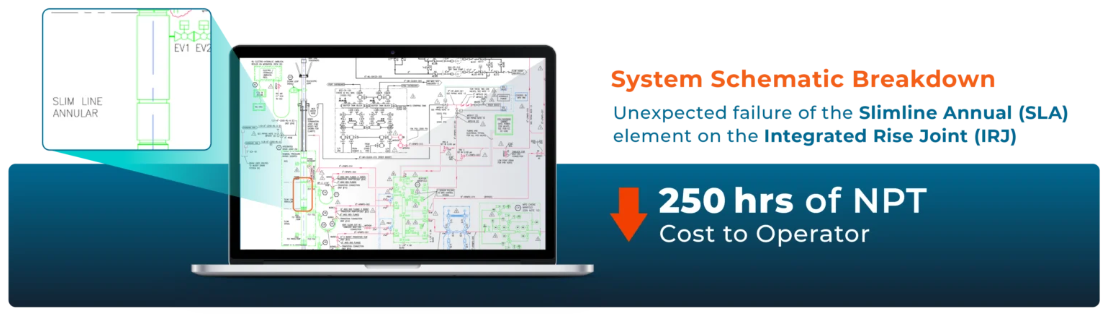
During a technology review, the operator approached IPT Global to evaluate whether digital real-time and MPD integrity management analytics could better support early detection of equipment degradation. They tested whether IPT Global’s Equipment Health Monitoring HealthAnalytics module could analyze MPD control data without context, manual tagging, or event descriptions.
To create a blind test, the operator provided a set of sanitized CSV files from the Transocean drillship MPD system; the files contained only raw time-series data from the SLA subsystem. Using this data set, IPT Global evaluated whether HealthAnalytics could pinpoint the failure window and detect the signal patterns that occurred beforehand.
IPT Global prepared the files, reformatted them, and ingested them into the Equipment Health Monitoring system. This software uses model-driven workflows designed for well control equipment testing, MPD failure analysis, and condition-based monitoring. It evaluates pressure response, hydraulic behavior, and closure performance to identify changes that indicate abnormal equipment performance or early-stage degradation.
Within minutes of data ingestion, the system flagged unusual pressure and hydraulic patterns inconsistent with expected annular behavior. IPT Global engineers ran multiple analysis modes over the next 48 to 72 hours to validate the signal patterns. Ultimately, the results consistently pointed to the same failure window later confirmed by the operator and the OEM.
The analysis identified a distinct deviation in the annular element’s pressure and hydraulic response with progressive wear. Importantly, this pattern was detectable days before the failure became visible.
“With IPT Global’s Equipment Health Monitoring, we saw in two days what took months to uncover,” said the operator’s Senior Advisor of Rig Systems. “That’s the kind of insight that changes how you think about equipment monitoring.”
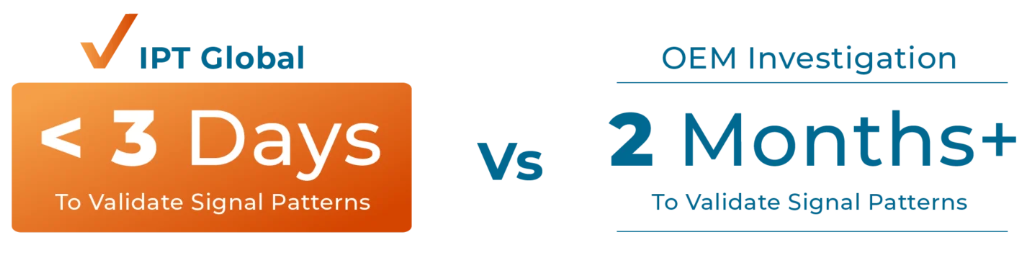
This case demonstrates how digital MPD integrity management testing can improve operational reliability and reduce NPT. By tracking baseline trends and small deviations, operators can detect MPD equipment wear early and improve maintenance and risk decisions.
IPT Global continues to expand its condition-based monitoring and predictive analytics for MPD systems, strengthening well control readiness, accelerating fault detection, and supporting a more proactive approach to equipment assurance. Contact us today to schedule a demonstration of Equipment Health Monitoring and learn how it can provide insight into the health of your operations.
For over a century, the oil and gas (O&G) industry has relied on circular chart recorders (CCR) to document the pressure tests that verify well integrity and protect personnel, assets, and the environment. A CCR uses a mechanical pen to trace pressure readings onto a rotating paper chart, which is then interpreted by eye. That makes the result only as reliable as the tester reading it, and small deviations can be difficult to see.
Digital pressure testing replaces that subjective read with an objective interpretation based on accurate, high-resolution data that is tamper-proof and auditable. Digital data also allows for Cloud-based archival of the well history and KPI tracking, which makes performance visible, helps to identify learning opportunities, and closes process safety gaps while reducing opportunities for human error.
Although the industry began moving away from CCRs more than a decade ago, they are still in use on many rigs. In 2020, IPT Global worked with a major operator to compare the two approaches—CCR and digital pressure testing—directly.
The operator, which runs active offshore and onshore operations worldwide, wanted to standardize assurance and efficiency across all of its business units and projects. That goal created an opportunity to improve its integrity validation workflows, from planning and execution to after-action reviews and data archival for their onshore operations.
IPT Global conducted the trial across four of the operator’s rigs, with CCRs and SureTec® PressureTesting run side by side. Our well integrity advisor then led after-action reviews with rig and office teams, focusing on operational changes made during testing, deviations from API standards, and a breakdown of online and offline testing time. Because the PressureTesting solution stores data in the Cloud, the team was able to analyze performance quickly.
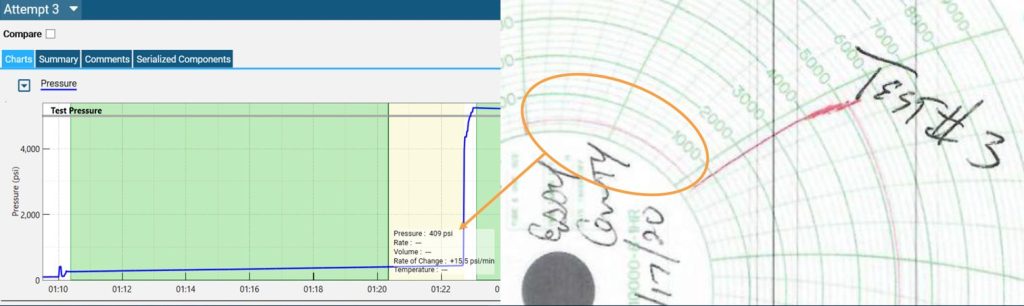
API Standard 53 requires that a low-pressure test shall pass between 250-350 psi. In figure 1, PressureTesting shows the low-pressure test was held at 409 psi, above the API Standard 53 range. On the CCR, that discrepancy is difficult to see, which leaves the result open to interpretation.
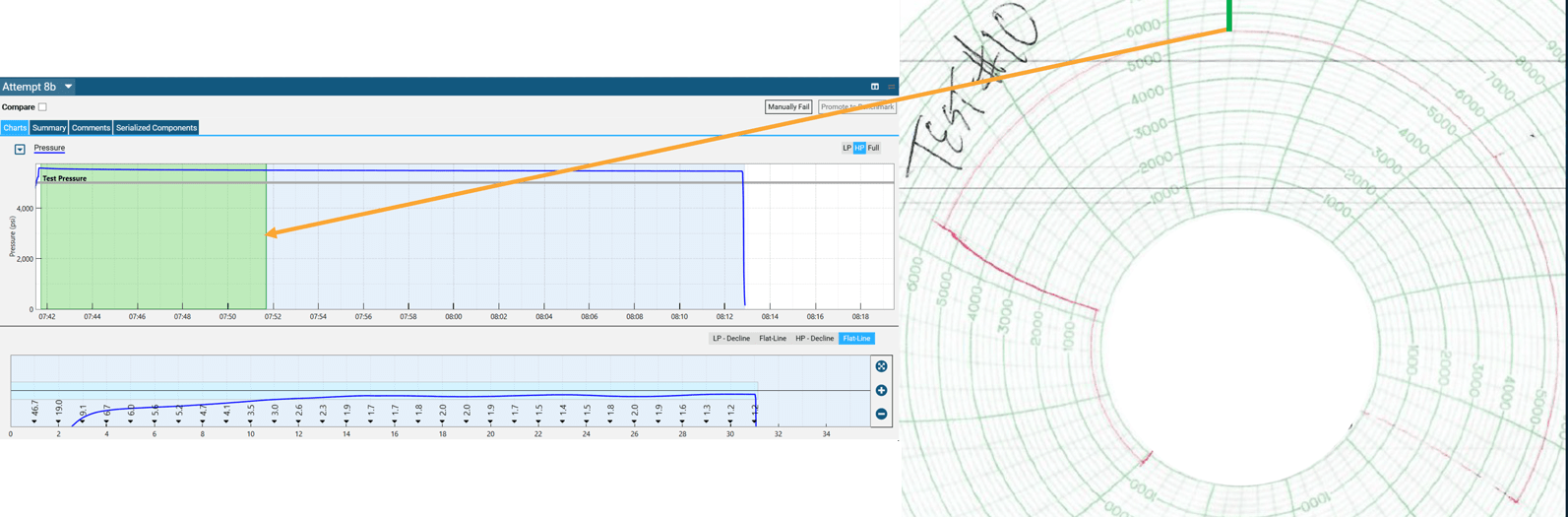
Illustrated in Figure 2, the test passed the approved criteria at minute 10 with PressureTesting. The test was held out for an additional 21 minutes on the CCR. This additional time was caused by the subjective review by the tester.
IPT Global and our client agreed on several KPIs and objectives for the trial. SureTec provided integrity, assurance, performance, and compliance not possible using an analogue approach and CCR. The trial highlighted the opportunities and influenced new standards and process improvements.
Benefits to the level of assurance provided by SureTec PressureTesting included:
This trial gave the operator a clear, data-backed view of what its CCRs were missing. SureTec PressureTesting delivered objective, tamper-proof, and auditable results for well barrier integrity validation, and the process and performance gaps it revealed led to lasting changes in the operator’s programs and standards.
As the operator put it during implementation, “I’m so happy we are making the switch. Using this digital tool and being involved in the digital transformation is critical for assurance and driving efficiency.”
If your operation still relies on circular chart recorders, contact IPT Global to see what digital pressure testing can show you.
A major operator invited IPT Global and another pressure testing company to a head-to-head trial on sister drillships in the Gulf of America. The trial aimed to evaluate the effectiveness and efficiency of each participant’s pressure testing application.
IPT Global analyzed the pressure tests using its patented advanced algorithms, while the competitor used “predictive” analysis, a form of standard decline analysis. Based on the results of these field trials, the operator deemed IPT Global’s SureTec® PressureTesting solution 20% more efficient than its predictive counterpart. Testing details and results are outlined below.
IPT Global delivers the most efficient and accurate pressure testing solution in the industry. Using proprietary physics-based algorithms, it’s the only method available on the market that delivers objective, unambiguous pass/fail test results based on real data. This enables IPT Global to routinely validate tests more efficiently than “predictive” competitors that are validating based on arbitrary coefficients and no data.
Employing physics-based algorithms, IPT Global’s PressureTesting solution can detect any deviations from expected test results, ensuring even subtle leaks are identified. This is achieved by comparing the results of similar pressure, volume, and temperature systems. These are critical variables that must be accounted for when predicting test results.
The head-to-head field trial took place on two sister drillships with similar BOP designs, operating in similar water depths with compatible wellbore designs. Both pressure testing companies performed a BOP latch-up test and two BOP interval tests using their respective analysis methods.
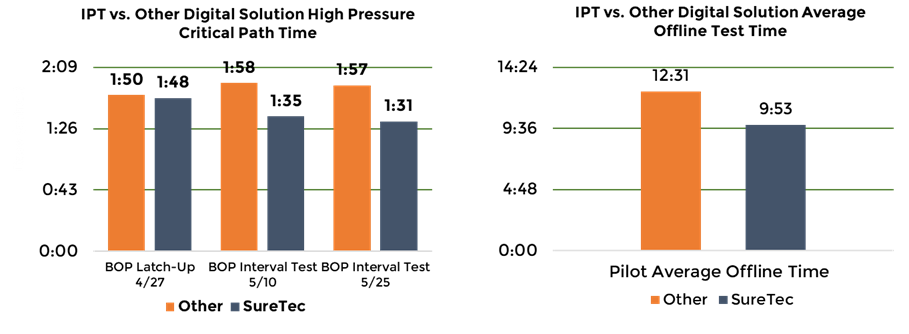
The results of the tests were gathered by the operator and presented to both parties (Figure 1). According to the operator, tests performed using SureTec PressureTesting were 20% faster than those using predictive methods. In addition to faster test validation, IPT Global provided a high level of integrity assurance using PressureTesting’s patented algorithms.
Ensure your testing on integrity-critical equipment and well barrier elements is accurate and effective with advanced leak detection from IPT Global’s SureTec PressureTesting solution. Our physics-based analysis validates results against real test data, rather than assumptions, so you get pressure testing results you can trust the first time.
Contact us today to see how PressureTesting can strengthen your next test program.
Most digital pressure testing applications on the market regularly pass leaks due to analysis that is not rooted in the physics of well operations. Operators and drilling contractors should be concerned that these black-box digital solutions are used to validate high-pressure tests on critical rig equipment.
The lack of accurate leak detection on blowout preventers (BOPs), production trees, and well barrier elements (WBE) increases the risk of process safety incidents, which puts operations at risk of harming the environment, people, and assets.
Many digital pressure testing alternatives falsely claim to be predictive by using a curve extrapolation for pressure decline analysis. There is no truly predictive product on the market that is based in well operation physics. However, one digital pressure testing solution using advanced analysis algorithms has transformed one of the industry’s most consequential assurance activities.
This case study shows how IPT Global’s SureTec® PressureTesting solution, using algorithms developed with the world’s largest pressure testing database, detected potential leaks that were missed by a competing digital pressure testing vendor in two high-pressure tests. Importantly, these tests were during live operations offshore.
Decline analysis uses a percentage of the required test pressure as the criteria to determine the allowable pressure drop over a given period (typically 5 minutes). For example, if a system has a test pressure of 10,000 psi and the vendor selects 0.5% as the decline criteria, then the acceptable pressure loss is calculated as follows:
Acceptable Pressure Loss = (Criteria x Test Pressure) = 0.005 x 10,000 psi = 50 psi
The same decline criteria and required test pressure were used in high-pressure tests on a cement unit and a low torque valve shown in Figures 1 and 2, respectively. During the tests, two data points (A and B) were selected five minutes apart by the competitor software. Using the above decline criteria, both tests passed because the respective pressure losses of 49 psi and 48 psi were less than 50 psi.
Using decline criteria alone to validate critical components ignores the thermal effects of pressurization on the system. Pressurization increases the temperature of the system, and the pressure decreases when the system cools during shut in.
It’s the same effect that occurs when car tires lose pressure in the winter. As a result, when the system is shut in to monitor the pressure, part of the pressure drop is due to cooling of the test fluid as the system loses heat to the surroundings. Because of its simplicity, standard digital testing utilizing decline analysis cannot distinguish between pressure loss due to thermal effects and pressure loss due to a potential leak.
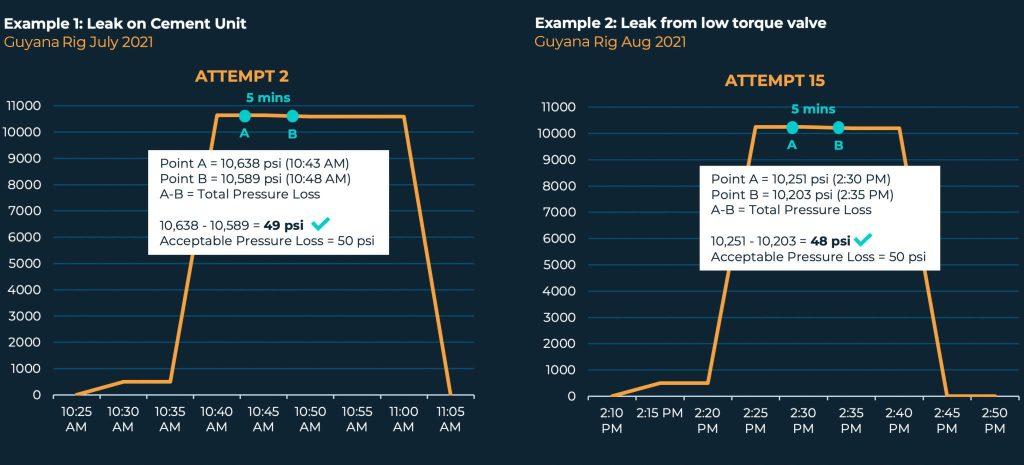
EXAMPLE 2: Example of a competitor digital solution passing a test with a pressure loss of 48 psi. This large pressure drop was allowed due to a lack of advanced algorithms, only available through IPT Global’s SureTec PressureTesting solution. PressureTesting removed the thermal influence and identified a leak on the lower torque valve.
To demonstrate that competing digital approaches are inadequate for leak detection, the same tests were analyzed using IPT Global’s PressureTesting solution with a field-tested, physics-based advanced analysis. This analysis uses strict criteria to detect a leak with a high level of confidence.
The IPT Global analysis failed the same tests that passed using a competing digital solution. IPT Global was able to differentiate thermal influences as the test fluid cooled off during testing.
Accurate leak detection depends on testing methods that go beyond simple curve extrapolation. IPT Global’s PressureTesting solution applies physics-based layered algorithm validation to confirm the integrity of critical equipment and well barrier elements with objective, repeatable results.
Contact us to learn how PressureTesting’s leak detection capabilities can support your operations.
The petroleum industry continues to rely on antiquated analog methodologies and individual experiences to interpret pressure tests. These tests are fundamentally critical to verifying well barrier integrity, which ensures protection of personnel, assets, and the environment.
Over a decade ago, IPT Global led a digital revolution with the development of industry-leading technology that modernized well barrier assurance. This case study examines how IPT Global worked with a major oil and gas (O&G) company to compare analog methods (circular chart recorder (CCR)) with IPT Global’s digital pressure testing solution.
The client’s shallow water and deepwater Gulf of America operations were early adopters of IPT Global’s SureTec® platform and PressureTesting solution, but the client still had several regional operations that used circular chart recorders, including drillships in West Africa and in several onshore basins. The comparison trials, conducted across both land and deepwater operations, evaluated IPT Global’s PressureTesting solution against circular chart recorders to quantify the value of adopting a global well assurance solution.
Ultimately, the trial demonstrated that SureTec PressureTesting created immediate value with enhanced efficiencies and time savings on the rigs. PressureTesting’s digital Cloud-based data and archival ensure long-term record preservation, guarantee compliance, and enhance safety across well barrier assurance processes in ways not possible with analog methodologies. Beyond the immediate value created with IPT Global’s digital pressure testing solution, the client also safeguarded long-term value by ensuring well barrier processes and program steps were consistently followed.
SureTec PressureTesting generated immediate value on the client’s projects compared to analog methods. IPT Global measured more efficient test validation times both onshore and offshore. The client also benefited from qualitative efficiencies in processes, communication, and generating information that could be applied to continuous performance improvement.
In addition to immediately reducing costs through more efficient and effective operations, IPT Global’s PressureTesting solution revolutionized the client’s assurance, confirming well barriers will perform as planned so that the operator’s reputation and license to operate was protected. The regional projects that were still using analog methods to verify barrier integrity posed invisible risks that would remain unknown until after a catastrophe occurred. Implementing PressureTesting created opportunities to close process safety gaps across all of the client’s operations.
Prior to the comparison trials, some of the client’s staff believed a “free” solution would be sufficient to carry their operations. The side-by-side comparison left no question that SureTec PressureTesting, IPT Global’s digital pressure testing solution, generated and preserved value.
In addition to validating tests 30% and 25% more efficiently, for onshore and offshore respectively, major efficiencies were gained from improved performance enabled through visible data, enhanced change management, collaboration, and auditable record keeping. The operator has implemented IPT Global’s PressureTesting solution into all global operations as part of their assurance and integrity program, providing peace of mind that all their operations would comply with internal and regulatory standards to ensure well barrier integrity. This enterprise-level assurance minimizes client exposure to well integrity incidents that could impact people, assets, and the environment.
During the implementation of SureTec, a client remarked, “I’m so happy we are making the switch. Using this digital tool and being involved in the digital transformation is critical for assurance and driving efficiency.”
Contact us today and let IPT Global be a part of your digital transformation. With SureTec PressureTesting and our broader well assurance solutions, you can turn digital data into real cost savings while strengthening the assurance that protects your company’s reputation and license to operate.