MPD Equipment Failure Case Study: Early Detection of MPD Annular Wear Using Digital Diagnostics
November 15, 2025
Managed Pressure Drilling (MPD) systems operate under demanding conditions, where small deviations in pressure or hydraulic behavior can escalate into equipment failure, unplanned nonproductive time (NPT), and increased well control risk. Traditional well control equipment testing often depends on manual interpretation, delayed reporting, and limited visibility into early degradation trends.
In this analysis of MPD equipment failure, we examine how a major offshore operator used MPD control system data and IPT Global’s digital diagnostics to identify the deviation pattern that preceded a Slimline Annular (SLA) element failure. The analysis shows how automated MPD failure analysis and equipment healthworkflows for can reveal early indicators of annular wear long before visible damage.
The Challenge: Undetected Annular Damage and Significant NPT
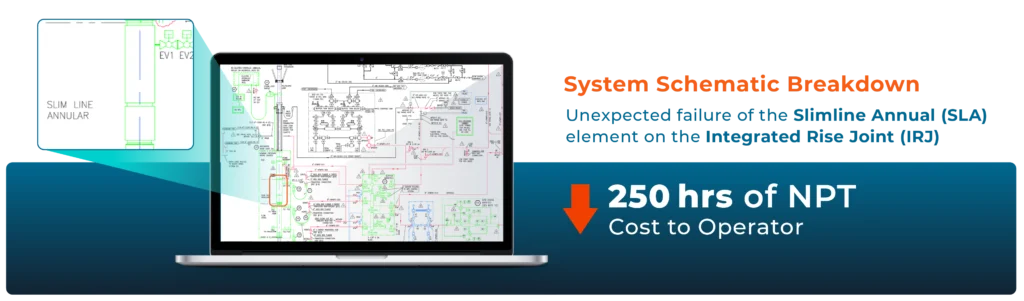
The operator experienced an unexpected failure of the Slimline Annular (SLA) element on the Integrated Rise Joint (IRJ) after less than two months of deployment and only 13 closures. During retrieval, the rig team discovered large pieces of degraded rubber in the trip tank and on top of the wear bushing.
The failure resulted in more than 250 hours of NPT. While the root cause was established through a lengthy investigation by the Original Equipment Manufacturer (OEM), the operator wanted to determine whether early indicators were present in the MPD control system data and if digital analysis could have detected the problem sooner.
This case raises two key questions for the operator:
How can early MPD equipment degradation be detected before it becomes disruptive?
Can digital MPD testing, MPD integrity management workflows, and equipment health analytics provide an early warning of well control equipment issues?
Figure 1. IPT Global’s MPD Asset Health dashboard enabled the operator to analyze annular pressure response trends and identify early signs of Slimline Annular (SLA) element degradation ahead of failure.
The Solution: Applying IPT Global’s Digital Diagnostics to Real-Time and Historical MPD Data
During a technology review, the operator approached IPT Global to evaluate whether digital real-time and MPD integrity management analytics could better support early detection of equipment degradation. They tested whether IPT Global’s Asset Health Platform could analyze MPD control data without context, manual tagging, or event descriptions.
To create a blind test, the operator provided a set of sanitized CSV files from the Transocean drillship MPD system. The files contained only raw time-series data from the Slimline Annular subsystem. Using this data set, IPT evaluated whether the Asset Health Platform could pinpoint the failure window and detect the signal patterns that occurred beforehand.
IPT prepared the files, reformatted them, and ingested them into the Asset Health Platform. This system uses model-driven workflows designed for well control equipment testing, MPD failure analysis, and condition-based monitoring. It evaluates pressure response, hydraulic behavior, and closure performance to identify changes that indicate abnormal equipment performance or early-stage degradation.
Results: Rapid Detection, Accurate Insights, and Validated Failure Indicators
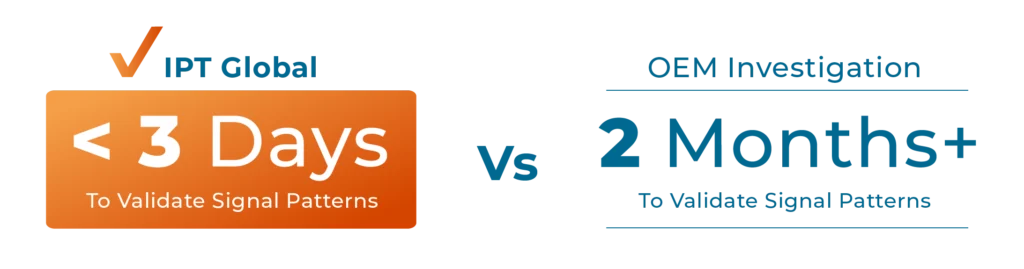
Within minutes of data ingestion, the system flagged unusual pressure and hydraulic patterns inconsistent with expected annular behavior. IPT engineers ran multiple analysis modes over the next 48 to 72 hours to validate the signal patterns. Ultimately, the results consistently pointed to the same failure window later confirmed by the operator and the OEM.
Key outcomes
Rapid Insight: Anomalies were detected within minutes of data loading
Accurate Identification: The platform’s analytics pinpointed the exact failure date and the degradation trend leading up to the event
Significant Efficiency Gain: IPT reached validated conclusions in < 3 days, compared to several months of manual OEM investigation
No Manual Tuning Required: The system analyzed the MPD data automatically, without contextual prompts or human adjustment
The analysis identified a distinct deviation in the annular element’s pressure and hydraulic response with progressive wear. Importantly, this pattern was detectable days before the failure became visible.
“With IPT’s Asset Health Platform, we saw in two days what took months to uncover,” said the operator’s Senior Advisor of Rig Systems. “That’s the kind of insight that changes how you think about equipment monitoring.”
Figure 2. IPT Global’s MPD integrity workflows support proactive, data-driven condition monitoring that reduces NPT and improves equipment assurance.
Conclusion: Advancing MPD Integrity Management Through Digital Analytics
This case demonstrates how digital MPD integrity management testing can improve operational reliability and reduce NPT. By tracking baseline trends and small deviations, operators can detect MPD equipment wear early and improve maintenance and risk decisions.
IPT Global continues to expand its condition-based monitoring and predictive analytics for MPD systems, strengthening well control readiness, accelerating fault detection, and supporting a more proactive approach to equipment assurance.
Strengthen your MPD integrity strategy with digital diagnostics.
IPT Global’s digital diagnostics and automated testing workflows give operators clearer visibility into MPD equipment performance and support faster, more confident well control decisions.
IPT is committed to providing best-in-class customer service and support. If you need help choosing a solution that’s right for you, or if you need a hand from a pro in our 24/7 Real-Time Operations Center, we’re ready to serve you.