
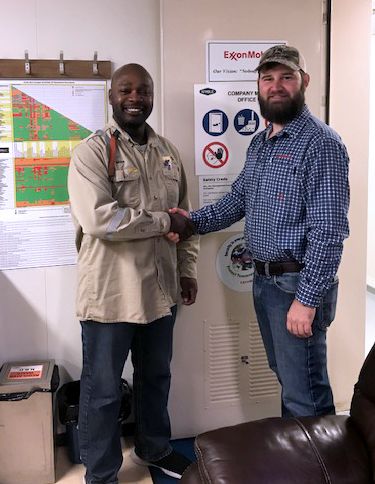
Michael Barat-Arboine was recognized by ExxonMobil as catch of the week for noticing a lifeboat’s maintenance pennants did not have secondary retention to properly secure them to their mounts.
Michael noticed the maintenance pennants for the life boat did not have secondary retention to properly secure them to their mounts.
Michael called the bridge and notified them of the discrepancy and how important it is to ensure the pennants were properly secured with secondary retention. The bridge team immediately responded and installed secondary retention to ensure all possible dropped object hazards were eliminated.
IPT’s team of trained and experienced experts will assist you with your operations to enhance your assurance and efficiency. Contact us today to learn more about how our team can help you!
IPT Global’s services and technologies came together to deliver value to all stakeholders during a well intervention program in Angola, off the west coast of Southern Africa. The intervention services company (ISC) had an extensive program and its objective was to have its personnel perform the integrity tests with remote support from IPT, which includes our Field Advisors and Real-Time Operations Center (RTOC). The ISC’s goal was to demonstrate the ability to provide turnkey intervention services for various operators. IPT’s team worked with the ISC to create a custom operational support plan that consisted of in-house and on-site training, planning and test execution optimization, and remote support.
IPT provided pre-deployment training at its office for the ISC’s engineers and managers. The training focused on using existing test plans to run tests and publish reports. Several variations of the test plans were run using existing schematics. IPT provided setup guides for the digital acquisition (DAQ) unit and transducers, along with quick start guides to run various tests in SureTec. The participants were able to experience live data acquisition via the SureTec simulator, allowing them to become familiar with the SureTec interface during testing.
At the site, IPT’s Field Advisors trained intervention personnel so they could run SureTec with remote support from our RTOC. The training focused on using a testing matrix to guide testing efforts, leveraging the RTOC for remote support and publishing tests. IPT’s RTOC and engineers helped to manage the testing program with handover and record archival while transitioning between wells.
The operator planned 28 integrity tests, with specific criteria for each of the test types performed. IPT engineers created a test matrix for the ISC that included the operator’s criteria and a procedural reference for each test, making review and approval easier. The test matrix also helped ISC personnel to manage the testing program by making it easier to locate and run previously built test plans on the testing laptop. This allowed the company to focus on their operations and setting up the hardware rather than having to set up each test plan.
Completed tests and reports were uploaded to SureView for archival and traceability. SureView is a secure, web-based tool that also provides real-time status of pressure tests, test data organization and retrieval by well and date, advanced data analysis, and remote viewing of active tests.
The ISC received remote support from our RTOC, which is staffed by engineers and experienced advisors (RTOAs) who monitor all pressure tests 24/7 and provide global technical support. Remote support ranges from assisting with data connections, networking issues, and basic software issues to advanced support such as:
The intervention program required 28 integrity tests with various operator criteria to be performed over a relatively short period. The ISC successfully executed the intervention program and achieved its primary goal of providing turnkey service with technology and remote support from IPT. SureTec’s digital accuracy, objectivity, and flexibility assured the integrity of all tested components according to the operator’s criteria. Our engineers performed post-test reviews to ensure that all components were tested to the proper pressure as dictated by the operator. Our RTOAs verified that test reports were published properly to assure the traceability of all integrity tests for hand off to the production team and to provide an auditable trail of compliance for local regulatory bodies.
In addition, the integrity tests had to be performed safely and efficiently to avoid costly rig-time delays. Preparation began with effective training of the intervention crew by our experienced trainers. Our engineers assisted the operator and ISC by building accurate test plans and creating a test matrix that reduced the possibility of delays due to human error and increased the efficiency of hardware setup by the production and intervention crews. Most importantly, the ISC was able to deliver the intervention program safely to protect people, the environment, assets, and the reputations of all stakeholders.
To learn more on how our integrity solutions can you provide you the assurance necessary for well interventions, contact us!
For over a century, the oil and gas industry has relied on outdated technology and individual experience to interpret pressure tests that are critical to verifying well integrity for the protection of personnel, the environment and equipment.
Digital pressure testing provides an objective interpretation using accurate and high-resolution data that is tamper-proof and auditable. Additionally digital data allows for cloud-based archival of the well history and KPI tracking to make performance visible to identify learning opportunities, and close process safety gaps while reducing opportunities for human error.
An important and visible change associated with digital data was the move 10+ years ago away from circular chart recorders (CCR). In 2020, IPT worked with a major oil and gas operator to run a direct comparison between CCRs and the IPT approach of digital pressure tests provided through SureTec.
A major client with active, global operations offshore and onshore sought to address: “how to standardize assurance and efficiency across all business units and projects?”
This was the perfect time for IPT to work with the client to improve integrity validation workflows, from planning and execution to after-action reviews and data archival.
IPT ran a comprehensive comparison trial of CCRs vs. digital pressure tests provided by IPT’s software SureTec across four of the operator’s rigs. Our well integrity advisor led after-action reviews with rig and office teams.
With the goal of standardizing the validation workflow, we highlighted operational changes during the test, deviations outside of API standards and specific KPIs on time breakdown for online and offline testing. The cloud-based data storage enabled rapid performance analysis.
IPT and our client agreed on several KPIs and objectives for the trial. SureTec provided integrity, assurance, performance and compliance not possible using an analogue approach and CCR. The trial highlighted the opportunities and influenced new standards and process improvements.
Benefits to the level of assurance provided by SureTec included:
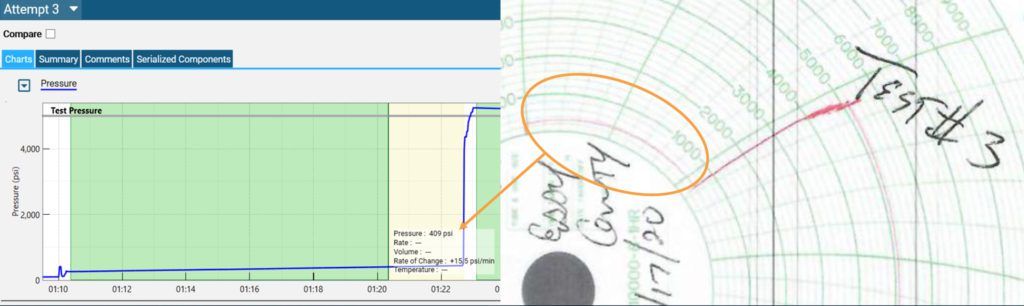
API Std 53 requires that a low-pressure test shall pass between 250-350 psi. The images in figure 1 demonstrates the CCR test passed at 409 psi. The lack of detail from the CCR does not clearly demonstrate small discrepancies with the regulations and leaves the results open to interpretation.
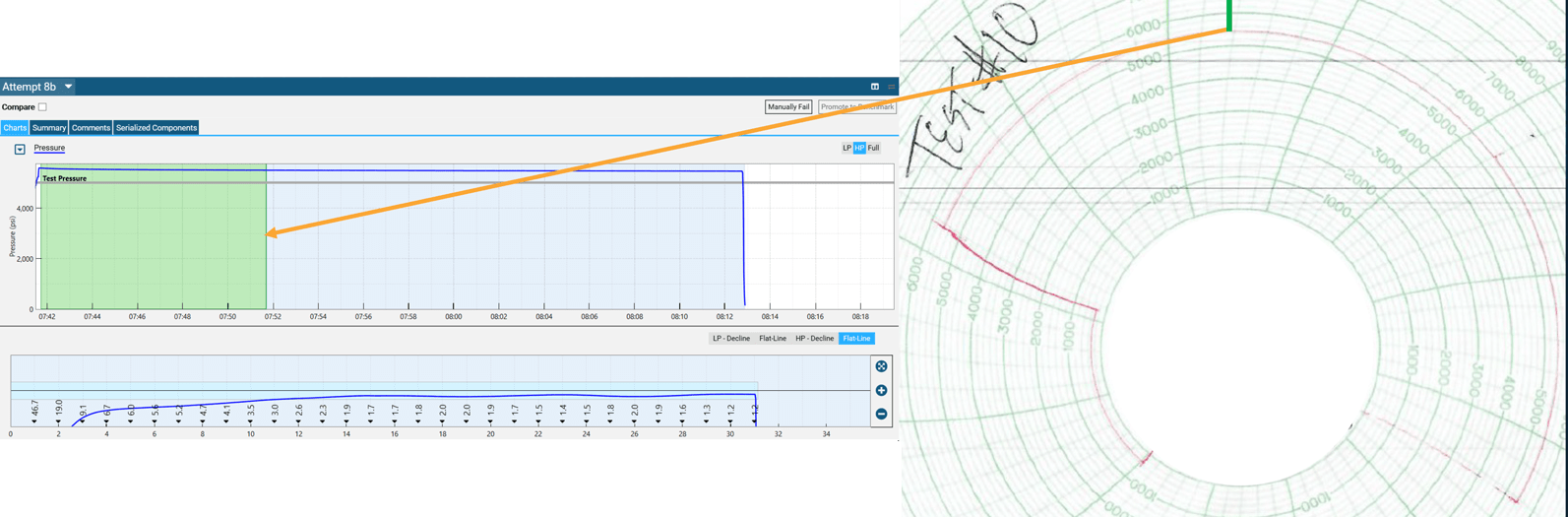
Illustrated in the Figure 2, the test passed the approved criteria at minute 10 (SureTec). The test was then held out for an additional 21 minutes on the CCR. This additional time was caused by the subjective review by the tester.
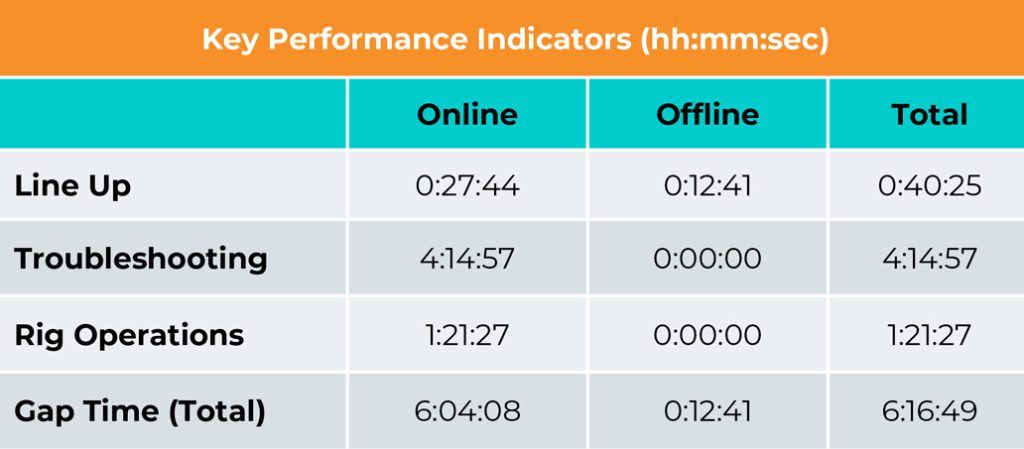
The below table (Figure 3) provides details on gap time analysis. Understanding and tracking these gap times helps drive efficiency and lessons learned.
IPT partnered with a global operator to drive integrity and assurance standardization across its business units by introducing digital pressure tests utilizing the industry-leading technology software, SureTec.
IPT’s solutions provided objective, tamper-proof and auditable results for well barrier integrity validation. Process and performance opportunities were easily identified that were used to make sustainable changes to programs and standards.
During the implementation of SureTec, our client said, “I’m so happy we are making the switch. Using this digital tool and being involved in the digital transformation is critical for assurance and driving efficiency.”
Let IPT be a part of your digital transformation and benefit from the application of digital data to drive efficiency and improve assurance.
IPT Global had the privilege of collaborating with University of South Carolina Upstate Master of Science in Business Analytics students in their Spring 2022 MSBA 790 capstone course through an experiential learning partnership provided by CapSource.io. The project’s objective was calculating the greenhouse gas emissions savings we provide for our clients. This was a high-impact experiential learning project for students at the University of South Carolina Upstate with a legitimate industry case study and dataset. Experiential learning is a type of program that students, educators, and sponsoring companies can benefit from by creating impactful products that solve real industry problems. By the end of the project the students gained career experience in using key analysis skills with industry leaders who guided and provided meaningful feedback throughout the program.
Seven candidates from the Master of Business Analytics program at the USC Upstate College of Business and Economics were tasked with a visualization and research project developed by IPT Global to determine our client’s CO2 emissions savings. The project was guided by our Data Science Team Lead, Bryan Spencer, as the technical point of contact and project manager and Dr. Uma Gupta, the student’s professor and advisor. Throughout the project they helped provide insight and guidance.
The students were tasked with building a visualization tool or dashboard that allows the end user to quantify the greenhouse gas (GHG) emissions reductions from time savings gained using IPT Global’s software suite. These beneficial time reduction improvements were a result of efficiency in testing from the use of our proprietary algorithms and operational optimizations through remote monitoring, streamlined processes, and other IPT solutions. The students performed significant research to be able to estimate the overall GHG emissions from specific operations and discover how it impacts the overall carbon severity of an offshore oil and gas well.
Through guidance from the project manager of IPT Global, Bryan Spencer and the instructor Professor Uma Gupta, the students built a Tableau dashboard that was able to identify the GHG emissions reductions our clients received from using our SureTec software. The dashboard was able to differentiate between operations on jack-ups, semi-subs, and drillship rigs. In addition, the dashboard offered guidance on whether a rig could save more through further streamlining operations. The students investigated multiple operational factors to identify the optimal amount of savings a rig could obtain and compared it to current operation savings to identify room for improvement and future operational goals.
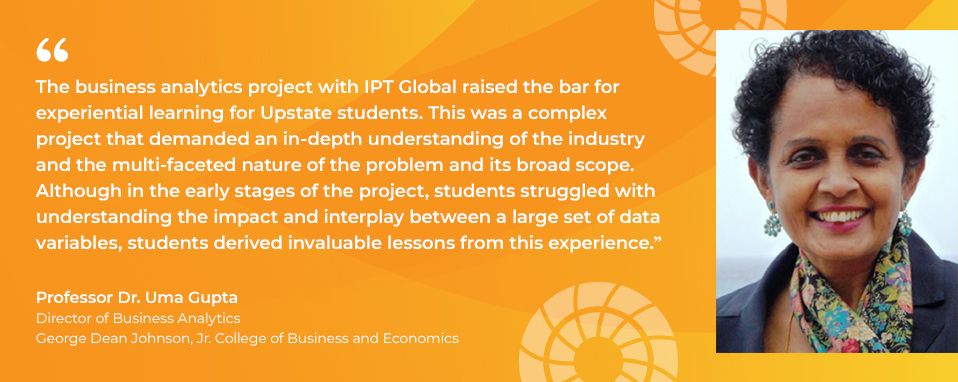
This project was very significant and beneficial to the MBA program at USC Upstate. Professor Dr. Uma Gupta stated this about the experience, “The business analytics project with IPT Global raised the bar for experiential learning for Upstate students. This was a complex project that demanded an in-depth understanding of the industry and the multi-faceted nature of the problem and its broad scope. Although in the early stages of the project, students struggled with understanding the impact and interplay between a large set of data variables, students derived invaluable lessons from this experience. The project was both inspiring, given the focus to reduce greenhouse gas emissions, and simultaneously challenging. The leadership of Cody MacDonald and Bryan Spencer is noteworthy. Program sponsors play an important role in the success of all projects. Bryan Spencer spent many evenings sharing his knowledge and guiding students to address the inevitable challenges that arise in a project of this nature. In his own gentle way, he prodded students to be intellectually curious and practical at the same time. USC Upstate is grateful for this partnership and looks forward to working with IPT Global in the future.”
IPT Global was grateful to work with the students at USC Upstate over the course of this project. We are looking forward to incorporating this work into our products and displaying the greenhouse gas emission savings for our clients on dashboards. This will show the immense value IPT provides in efficiency and environmental impact through emissions savings. Contact us to learn more about how we can make your operations more efficient and reduce your greenhouse emissions.
A single event involving the malfunction or failure of a blowout preventer (BOP) component can result in unplanned downtime on a drilling rig, costing millions of dollars. These events can add up throughout the equipment’s lifecycle to a significant amount of cost and lost time. Due to uncertainty about the lifecycle of BOP stack components, drilling contractors may arbitrarily replace components during scheduled maintenance to try to mitigate unplanned downtime.
Additionally, history has proven that a malfunctioning BOP component can result in a loss of well control, threatening the safety of people and the environment. As a result of the significant safety risks, the Bureau of Safety and Environmental Enforcement (BSEE) established regulations, described below, that require operators to develop and implement BOP real-time monitoring (RTM).
This article describes how IPT’s BOP Reliability System (BRS) helped a customer to identify a malfunctioning BOP control system component so it could be replaced during scheduled maintenance before it caused an interruption in drilling operations or a loss of well control.
IPT provides full monitoring services of well control equipment (WCE) data, downhole drilling data and tools. Specifically for BOPs, we offer a suite of services to ensure BOP reliability and efficiency. These services include WCE surveying and verification, monitoring by highly skilled experts, advanced data analytics for maintenance planning and compliance consulting.
This approach of monitoring and the application of advanced data analytics move the maintenance program from schedule-based approach toward a condition-based system, improving efficiency and reducing risk.
Historically failures have driven BOP maintenance response, the RTM move toward pro-active maintenance increases awareness of equipment condition (and therefore risk) using monitoring, alarms and alerts.
In early 2022, an IPT BOP analyst was monitoring a surface BOP control system on a jack-up rig in the Gulf of Mexico. The experienced and trained analyst was able to identify a possible failure ahead of an event, ensuring the rig avoided unplanned downtime.
In this example, the issue was with the BOP manifold regulator, which was supplied with 3000 psi from the accumulator bank. The manifold regulator reduces the supply pressure to 1500 psi for operation of the BOP pipe rams, blind shear rams (BSRs), and choke and kill valves. While monitoring the accumulator, the BOP analyst noticed that the manifold regulator showed an increased leak off rate after the BSRs were functioned closed (see graph below). In this case, the 1,500 psi manifold regulator pressure was deviating by more than 25 percent. Although it is not uncommon for a regulator’s pressure to vary, the BOP analyst knew that the level of deviation likely indicated an eminent component failure or a leak in the hydraulic circuit.
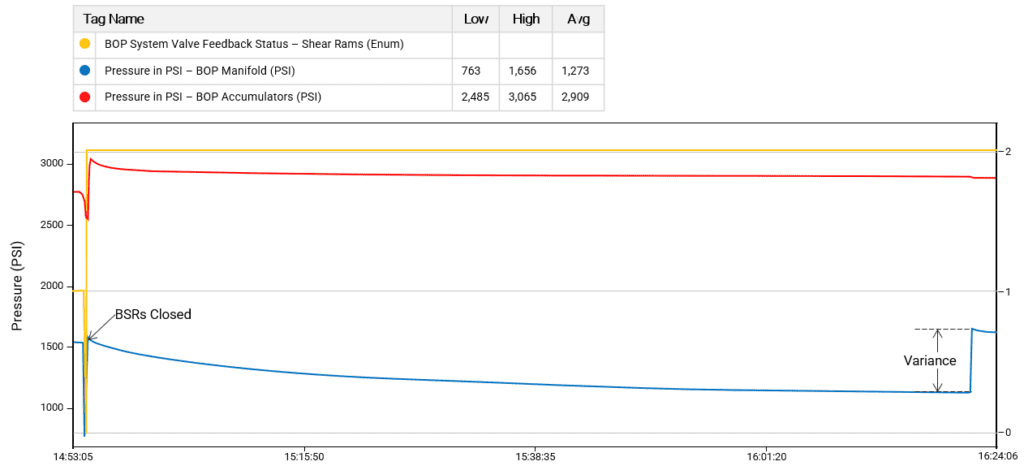
After our BOP analyst logged the event, the customer was notified of anomalous regulator behavior. When IPT provided comparative trends from other regulators, the drilling supervisor determined that the regulator should be replaced during scheduled maintenance to avoid disrupting future drilling operations.
The customer replaced the regulator before commencing drilling operations on a sister well. Subsequent BOP monitoring showed that the new regulator was operating normally. Notably, the customer also provided the new regulator’s certification for documentation in IPT’s database for future lifecycle tracking.
IPT’s RTM service and the customer’s proactiveness to replace the manifold regulator potentially avoided a very expensive BOP failure during drilling operations, as well as reduced risk to people and the environment. The outcome also shows how drilling contractors can reduce expenses by focusing on components that need to be replaced during scheduled maintenance rather than arbitrarily replacing components.
The BSEE Code of Federal Regulations (CFR) requires operators to provide real-time monitoring (RTM) for BOPs in the Gulf of Mexico. BSEE CFR Chapter II – Subchapter B – §250.724 (a) describes the RTM requirements as follows.
(a) When conducting well operations with a subsea BOP or with a surface BOP on a floating facility, or when operating in a high-pressure, high-temperature (HPHT) environment, you must gather and monitor real-time well data using an independent, automatic, and continuous monitoring system capable of recording, storing, and transmitting data regarding the following:
(1) The BOP control system;
(2) The well’s active fluid circulating system; and
(3) The well’s downhole conditions with the bottom hole assembly tools (if any tools are installed).
Our BRS is helping operators and drilling contractors to gain knowledge about the lifecycle of critical BOP components so they can increase BOP reliability and decrease costs through targeted preventative maintenance. For more information about our BOP Reliability System, contact us.
A major operator invited IPT and a competitor to a head-to-head trial on sister drillships in the Gulf of Mexico to evaluate the effectiveness and efficiency of each participant’s pressure testing application.
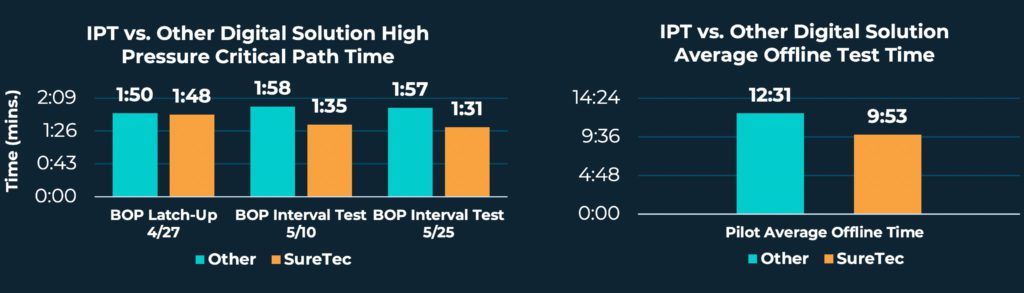
IPT was deemed by the operator to be 20% more efficient than its predictive competitor based on field trials.
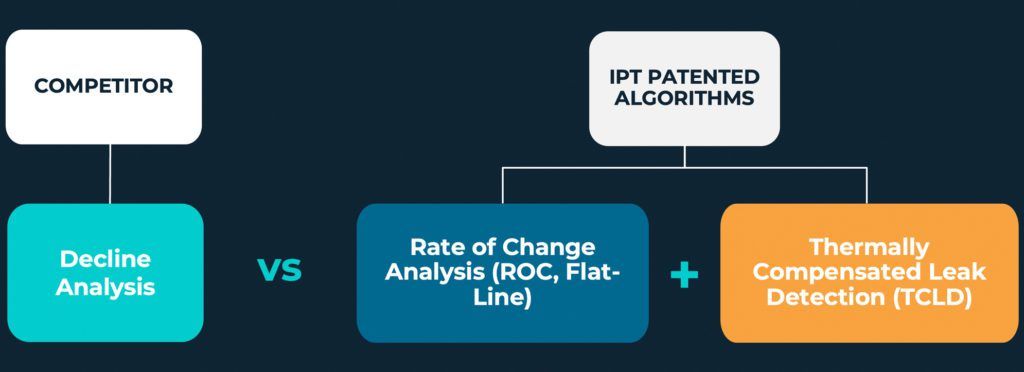
IPT analyzed the tests using its patented advanced algorithms while the competitor used “predictive” analysis, which is a form of standard decline analysis. The results are presented below after a description of TCLD Analysis.
Thermally Compensated Leak Detection (TCLD) delivers the most efficient and accurate testing in the industry. TCLD is the only analysis available on the market that predicts test results based on real data. This enables IPT to routinely validate tests more efficiently than “predictive” competitors that are validating based on arbitrary coefficients and no data.
TCLD can detect any subtle deviations from expected test results, ensuring even subtle leaks will be detected. This is achieved by comparing the results of similar pressure, volume and temperature systems. These are critical variables that must be accounted for when predicting test results.
The trial took place on two sister drillships with similar BOP design and operating within similar water depth and wellbore design. Both competitors performed a BOP latch-up test and two BOP interval tests. The competitor used a form of predictive decline analysis in the trial while IPT used its patented Advanced Analyses. (Figure 2).
The results of the tests were gathered by the operator and presented to both parties (Figure 3). According to the major operator, tests performed using SureTec were 20% faster than the competitor’s tests. In addition to faster test validation, IPT provided a high level of integrity assurance using SureTec’s patented algorithms.
Be sure that your testing on integrity critical equipment and well barrier elements is accurate and effective with advanced leak detection through IPT SureTec Advanced Leak Detection Analysis! IPT’s Advanced Leak Detection Algorithms are available in the Standard, Advanced, and Premier tiers of SureTec. Contact us today to learn how our advanced analysis can help you.
Digital pressure testing applications on the market regularly pass leaks due to a lack of advanced data analysis. Operators and contractors should be concerned that digital solutions use standard decline analysis to validate high-pressure tests on critical rig equipment and do not account for thermal effects.
This puts operations at risk of harm to the environment, people, and assets because of increased risk of process safety incidents due to lack of leak-detection on BOPs, production trees and well barrier elements.
Digital pressure testing alternatives falsely claim to be predictive by using a curve extrapolation for pressure decline analysis. There is no truly predictive product on the market that utilizes machine learning and artificial intelligence.
This case study shows how IPT’s proprietary algorithms detected potential leaks that were missed by another digital pressure testing vendor for two high-pressure tests.
Decline analysis uses a percentage of the required test pressure as the criteria to determine the allowable pressure drop over a given period (typically 5 minutes). For example, if a system has a test pressure of 10,000 psi and the vendor selects 0.5% as the Decline criteria, then the acceptable pressure loss is calculated as follows:
Acceptable Pressure Loss = (Criteria x Test Pressure) = 0.005 x 10,000 psi = 50 psi
The same decline criteria and required test pressure were used in high-pressure tests on a cement unit and a low torque valve shown in Figures 1 and 2, respectively. During the tests, two data points (A and B) were selected five minutes apart by the competitor software. Using the above decline criteria, both tests passed because the respective pressure losses of 49 psi and 48 psi were less than 50 psi.
Using decline criteria alone to validate critical components ignores the thermal effects of pressurization on the system. Pressurization increases the temperature of the system, and the pressure decreases when the system cools during shut in.
It’s the same effect that occurs when car tires lose pressure in the winter. As a result, when the system is shut in to monitor the pressure, part of the pressure drop is due to cooling of the test fluid as the system loses heat to the surroundings. Because of its simplicity, standard digital testing utilizing decline analysis cannot distinguish between pressure loss due to thermal effects and pressure loss due to a potential leak.
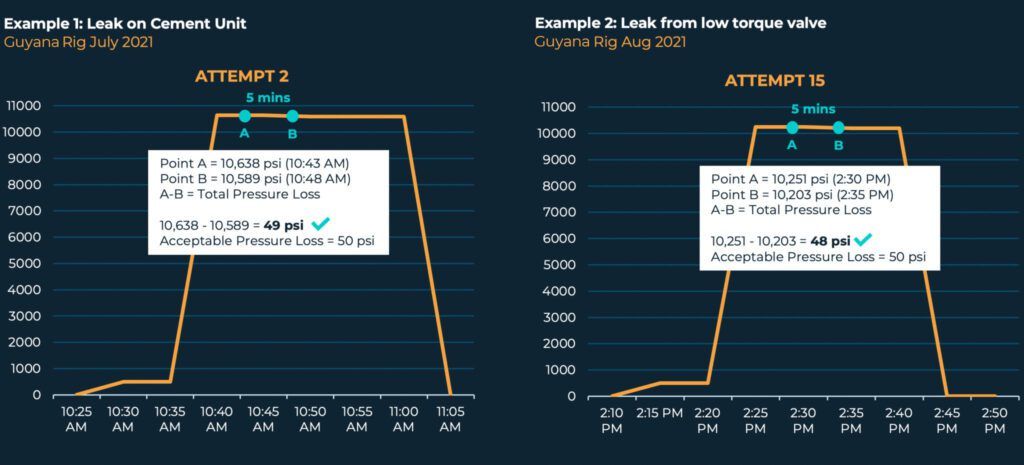
Example 1 – Example of competitor digital solution passing a test with pressure loss of 49 psi. This large pressure drop was allowed due to a lack of advanced algorithms, only available through IPT SureTec. SureTec removed the thermal influence and identified a leak on the cement unit.
Example 2 – Example of a competitor digital solution passing a test with a pressure loss of 48 psi. This large pressure drop was allowed due to a lack of advanced algorithms, only available through IPT SureTec. SureTec removed the thermal influence and identified a leak on the lower torque valve.
To demonstrate that competing digital approaches are inadequate for leak detection, the same tests were analyzed using IPT’s proprietary advanced analysis. This analysis uses strict criteria to detect a leak with a high level of confidence.
The IPT analysis failed the same test that passed using a competing digital solution. IPT technology was able to differentiate thermal influences as the test fluid cooled off during testing.
Be sure that your testing on integrity critical equipment and well barrier elements is accurate and effective with advanced leak detection through IPT SureTec Advanced Leak Detection Analysis! Contact us today to learn how our advanced analysis can help you.
In an industry first, IPT Global has enhanced their testing capabilities by connecting with downhole pressure gauges. SureTec software was successfully connected to data feeds from permanent downhole gauges in the completion in parallel to surface data feeds.
This integration enabled verification of pressure above and below the SCSSV valve and the top of the fluid loss isolation barrier valve in the lower completion. Simultaneous instances of SureTec were run, verifying the equipment during the completion installation and provided high confidence and assurance of the effectiveness of all barrier elements.
This breakthrough was performed on the recompletion of BP’s XP1 project and was accomplished by trapping pressure between the SCSSV and fluid loss valve.
The tests were validated using the upper gauge and applying inflow test criteria across the SCSSV, while at the same time using data from the Lower Gauge and applying positive test criteria to validate the completion between the SCSSV and the lower completion fluid loss valve.
The result was a successful verification of the completion barrier elements, proving the SCSSV in the direction of flow and providing remarkable confidence that the completion was installed with pressure integrity. Simultaneous testing added operational efficiency and reduced overall completion installation time.
The execution of the test required collaboration between IPT (field and software SMEs), the operator, and the gauge manufacturers. Once the correct equipment IP and Modbus addresses were aligned with the SureTec software, a thorough validation (and troubleshooting) process was completed to identify the individual pressure sources in SureTec and ensure the correct data was being received.
This is yet another notable example of IPT innovation and collaboration with clients to effectively enhance operations and increase critical path efficiency. Well integrity is crucial during well construction and completion operations; the application of SureTec eliminates subjectivity and future risk for IPT customers.
The BP Completions Engineer expressed his satisfaction with the SureTec setup, and the enhanced assurance it provided.
Lessons learned from this achievement are now part of the IPT “best practices” and will be applied in future installations. Ongoing research and improvements to processes and technology solidify IPT Global as the leader in Well Integrity and Assurance.
IPT partnered with a major global operator to standardize and optimize fleet-wide BOP testing. This collaborative initiative resulted in over 33 days or 800 hours of deepwater rig time savings per annum for the customer. In addition to creating value through gained efficiencies, IPT continues to protect value for this client through enhanced assurance of well barrier integrity across their operations.
Prior to this fleet-wide initiative, the major operator did not have a standard approach to BOP testing. Operations varied across regions and utilized a mix of SureTec, circular chart recorders, and competitor digital chart solutions. This was an opportunity to ensure effective implementation of process safety policies and to drive efficiency across global operations.
IPT’s performance advisor partnered with the client’s teams to ensure accelerated learning by utilizing big data and analytics that made performance visible and transparent. SureTec implementation increased efficiencies in regions where inferior solutions were previously utilized. Adoption of one standardized digital solution allowed for consistent assurance practices to meet internal requirements, compliance with regulatory requirements and remove sources of human error from operations.
During test design and planning, all test plans were created and optimized using SureTec’s tools to ensure compliance and consistency with company policy and regulations. IPT’s SMEs generated and optimized test plans based on decades of experience across multiple global operators. A wholesale reduction of three to four test steps per test resulted in reduced component wear and tear, extending mean-time between failures while reducing maintenance and operational time and costs across the fleet.
In addition to test step reduction and optimization, deepwater projects that adopted the digital solution to well barrier integrity testing benefited from over 25% time savings per test with IPT’s advanced algorithms. SureTec’s algorithms are not only fast and efficient, but are stringent and rigorous, providing industry-leading assurance that all leaks are detected early.
After global SureTec implementation, all of the regional operations were fully documented in standardized reports and archived in IPT’s cloud-based collaboration tool, SureView. IPT’s performance advisor consulted with the client teams to define custom performance metrics and KPIs to track with SureView. Once this information was transparent across the fleet, the team was able to identify opportunities for performance and process improvements and to share key learnings.
Through a collaborative and trusted partnership, a fleet-wide implementation of SureTec resulted in more than 800 hours or 33 days of critical path time savings per year for BOP testing. This was achieved through a global initiative to consult with IPT’s SMEs, who identified opportunities to reduce waste in test plans by eliminating steps; and by implementing the most efficient and robust digital solution for well barrier verification.
IPT’s performance advisor was able to provide a holistic perspective across the operations to share best practices, and identify accelerated learning opportunities that improved overall operational efficiency. Applying SureTec as a global digital solution was a critical step towards removing sources of human error from operations and to ensure that all regions were utilizing standard practices and procedures.
The petroleum industry continues to rely on antiquated analog methodologies and individual experiences to interpret pressure tests. These tests are fundamentally critical to verifying well barrier integrity which ensures protection of personnel, the environment and equipment.
Over a decade ago, IPT led a digital revolution and developed industry-leading technology to modernize well barrier assurance. Recently, IPT worked with a major oil and gas company to compare analog methods (circular chart recorder, CCR) with IPT’s digital well integrity management solutions.
The client’s shallow water and deep water Gulf of Mexico operations were early adopters of IPT well integrity solutions over a decade ago, but the client still had several regional operations that used circular chart recorders, including drillships in West Africa and in several onshore basins. The comparison trials ran on both land and deep water operations between IPT solutions and circular chart recorders to quantify the value in adopting a global well integrity management solution.
This trial demonstrated that the implementation of SureTec and SureView created immediate value with enhanced efficiencies and time savings on the rigs. Digital cloud-based data and archival ensure long-term record preservation, guarantee compliance and enhance safety across well barrier assurance processes in ways not possible with analog methodologies. In addition to the immediate value created with IPT solutions, the client’s value was was protected by assuring well barrier processes and program steps.
SureTec and SureView generated immediate value on the client’s projects compared to analog methods. IPT measured more efficient test validation times onshore and offshore. The client also benefited from qualitative efficiencies in processes, communication and generating information that could then be applied for continuous performance improvement.
In addition to immediately reducing costs through more efficient and effective operations, IPT solutions revolutionized the client’s assurance, confirming well barriers will perform as planned so that the operator’s reputation and license to operate was protected. The regional projects that were still using analog methods to verify barrier integrity posed invisible risks that would remain unknown until after a catastrophe occurred. Implementing the SureTec and SureView digital well integrity management system created opportunities to close process safety gaps across all of the client’s operations.
Prior to the comparison trials, some of the client’s staff believed a “free” solution would be sufficient to carry their operations. The side-by-side comparison left no question that SureTec and SureView, IPT’s digital well integrity management solutions, generated and preserved value.
In addition to validating tests 30% and 25% more efficiently, for onshore and offshore respectively, major efficiencies were gained from improved performance enabled through visible data, enhanced change management, collaboration and auditable record keeping. The operator has implemented IPT’s well integrity management solutions into all global operations as part of their assurance and integrity program, providing peace of mind that all of their operations would comply with internal and regulatory standards to ensure well barrier integrity. This enterprise level assurance minimizes client exposure to well integrity incidents that could impact people, equipment and the environment.
During the implementation of SureTec, a client remarked, “I’m so happy we are making the switch. Using this digital tool and being involved in the digital transformation is critical for assurance and driving efficiency.”
Let IPT be a part of your digital transformation and benefit from the application of digital data to drive cost savings and improve assurance to protect your company’s reputation and license to operate.