
The oil and gas industry generates vast amounts of data at every stage of the well lifecycle: exploration, drilling, completion, production and decommissioning. Yet much of it remains siloed and underutilized. The Open Subsurface Data Universe (OSDU™) addresses this challenge by providing a common framework for storing, accessing, and exchanging information across workflows.
At IPT Global, we believe the future of well assurance depends on combining advanced digital solutions with industry-wide standards. By aligning well integrity and operational data with these standards, operators gain new ways to improve efficiency, ensure compliance, and strengthen safety.
The OSDU Forum, launched by The Open Group, provides a neutral space where operators, service companies, and technology providers can standardize the way subsurface and operational data is structured, accessed, and shared. The Forum’s goal is to establish a common data platform that removes silos and promotes intergration across digital tools.
Through this collaboration, the Forum unites operators, service companies, and software providers to create shared standards and reference implementations, forming the foundation for managing and exchanging energy data.
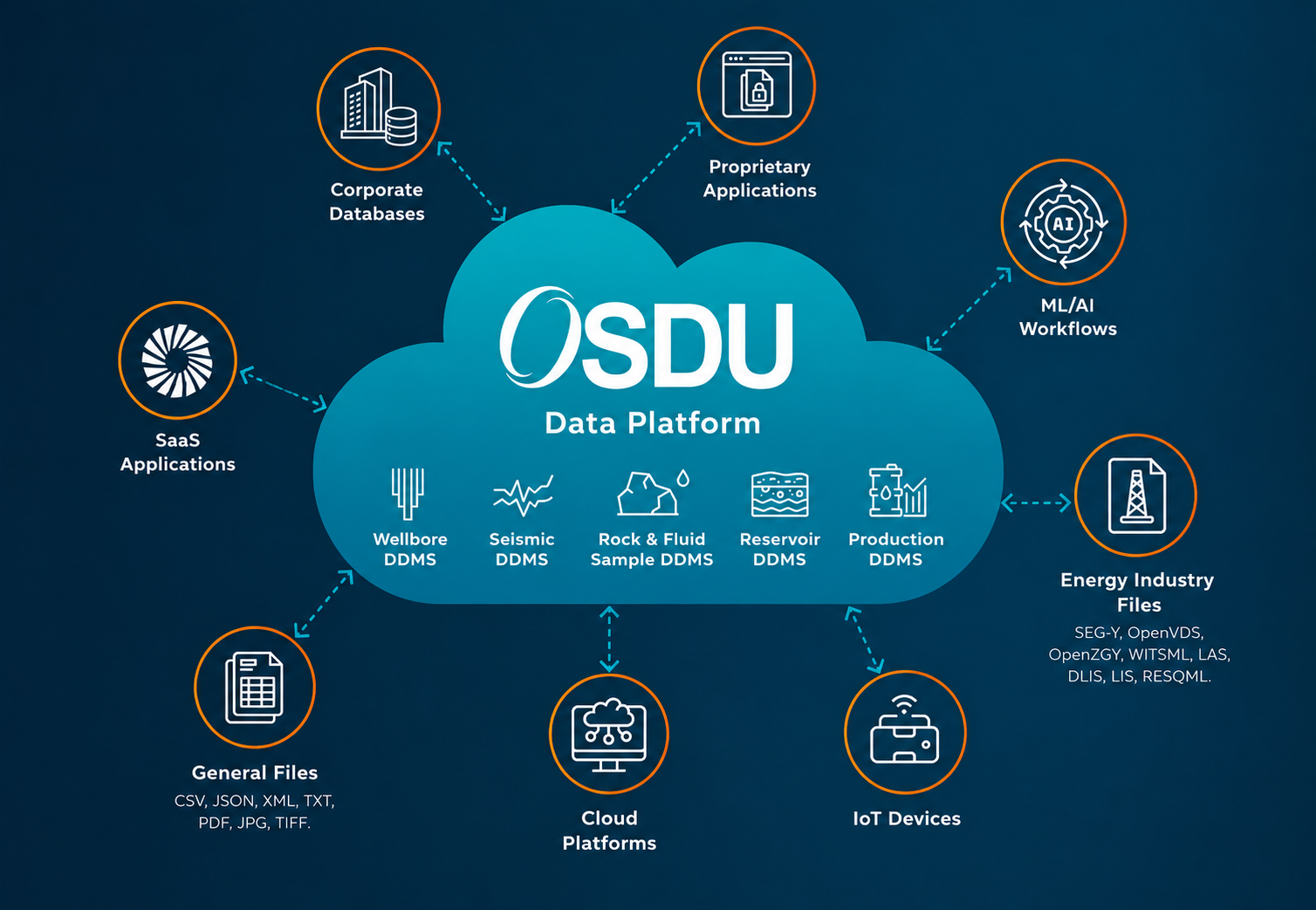
The OSDU Data Platform is an open-source, technology-agnostic environment created to eliminate silos and establish a single source of truth for subsurface, well, and operational data.
By providing a secure, scalable foundation, the framework makes information more accessible to operators, service companies, and regulators. This interoperability drives collaboration, speeds decision-making, and enables advanced digital solutions at scale.
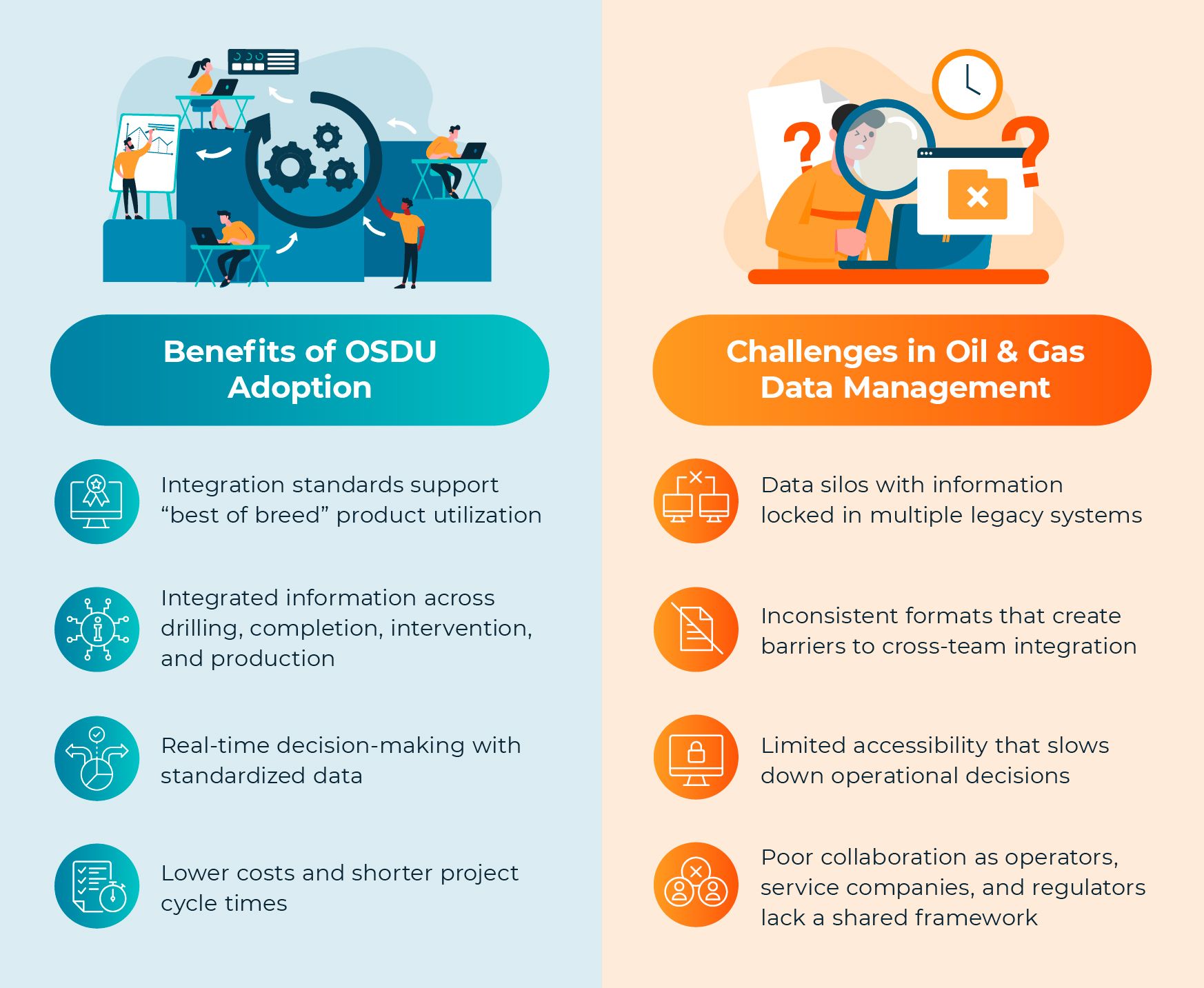
Oil and gas companies face persistent data management challenges, including siloed information, inconsistent formats, limited accessibility, and difficulties collaborating across operators, service companies, and regulators.
The OSDU data platform addresses these challenges by providing standardized frameworks and integration across workflows. Adoption of OSDU enables better data accessibility, faster decision-making, lower costs, and a foundation for advanced analytics like AI and machine learning.
The strength of OSDU lies in its reference architecture and standardized data schema. These define how subsurface and operational information is structured, ensuring it can flow seamlessly between different software and workflows.
At IPT Global, we actively contribute to this effort. Our teams have shaped the schemas for Well Barrier Element (WBE) and Well Control Equipment (WCE) Pressure Tests, and Well Schematic Diagrams, which are now part of the OSDU reference implementation. This work standardizes well integrity data and contextualizes it for use across drilling, completion, and abandonment workflows.
By working within the OSDU architecture, IPT Global eliminates inefficiencies of custom integrations and positions data for advanced analytics and automation.
As an active member of the OSDU Forum, IPT Global collaborates with industry leaders, technology providers, and regulators to advance open data standards. Together with other OSDU members, we contribute expertise in well assurance, pressure testing, wellbore schematics and barrier management to shape how operational data is stored and exchanged.
This role delivers IPT Global clients access to data models designed with real-world assurance workflows in mind, allowing them to adopt OSDU more efficiently and with greater value.
Our standards-based approach extends into IPT Global technology. Through secure application programming interfaces (APIs), we integrate well data, incorporate pressure test results, and connect with cloud-based data lakes. Built on service bus architecture, these integrations deliver information that is consistent, traceable, and actionable across planning, execution, and real-time operations.
By aligning our well integrity and barrier management solutions with the OSDU platform, IPT Global makes assurance data practical and accessible across day-to-day workflows.
The OSDU™ standard is transforming how oil and gas companies manage and use operational data. By replacing fragmented systems with a unified platform, operators can unlock greater value from their information and more effectively adopt advanced digital technologies.
At IPT Global, we put these standards into action. From structuring assurance data and standardizing formatting to embedding well integrity information into daily workflows, we provide the expertise and tools for end-to-end assurance.
Learn how data standards can be implemented to improve your well assurance.
Data integration, the process of unifying information from multiple sources, is essential for effective well integrity management. This includes gathering and analyzing data from various sources, such as well design and construction, continuous monitoring, and well integrity testing. By integrating data across all phases of a well’s lifecycle, operators gain a holistic understanding of well health, enabling more informed decision-making and improving safety and performance. This article explores how data integration optimizes well integrity management and the benefits it offers for optimizing well operations.
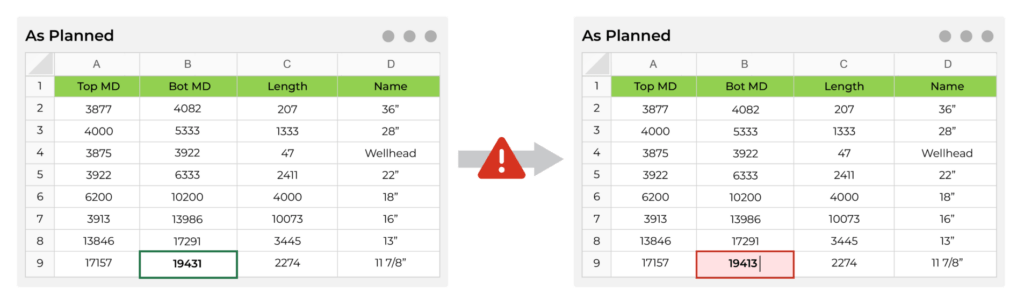
Wellbore data is often used across multiple systems, including well integrity management systems, but is typically entered manually into separate applications. For example, the same data might be used to generate wellbore schematics, barrier diagrams, and test plans—three distinct applications that don’t interact with one another. When wellbore data, such as casing, transitions from “as planned” to “as built,” it must be manually updated in one application (e.g., a spreadsheet) and then reentered into another application for the barrier diagram. This process repeats every time the data changes. Similarly, when a well schematic is used to develop a wellbore integrity test plan prior to operations, it must be updated with as-built data, and then the test plan needs to be revised accordingly. Additionally, wellbore data across different systems or regions may have varying structures or Units of Measurement (UoM), which can lead to issues such as calculation errors and data misinterpretation. This creates inefficiencies and increases the risk of inconsistencies whenever updates occur.
Integrating well integrity data unifies these workflows into a single application, enabling seamless communication of schematic and test plan changes while automating test planning and barrier management processes.
One of the leading causes—as much as 50%— of non-productive time (NPT) is the mechanical failure of equipment such as BOPs, subsea trees, and wellheads. There are more than 100 hydroelectric valves and regulators inside a BOP and historically, little was known about the fatigue life of these components. This lack of insight resulted in BOP manufacturers arbitrarily replacing as much as 25% of the BOP stack each time it underwent scheduled maintenance – an approach designed to prevent breakdowns but often resulting in excessive and unnecessary part replacements.
One of the most significant advantages of data integration in well integrity management is the ability to leverage predictive analytics for proactive maintenance and risk mitigation. By analyzing historical data and monitoring real-time data from multiple sources, operators can reduce the likelihood of well integrity issues that could lead to costly downtime or safety incidents. For BOPs, condition-based monitoring (CBM) allows potential problems to be predicted, based on the remaining service life of individual components. This enables BOPs to remain subsea longer without being retrieved to the rig for premature repairs. CBM also allows operators to schedule maintenance at optimal intervals, minimizing unnecessary NPT while ensuring equipment remains in reliable working condition. As a result, unplanned maintenance and production disruptions are reduced, contributing to improved operational safety and efficiency.
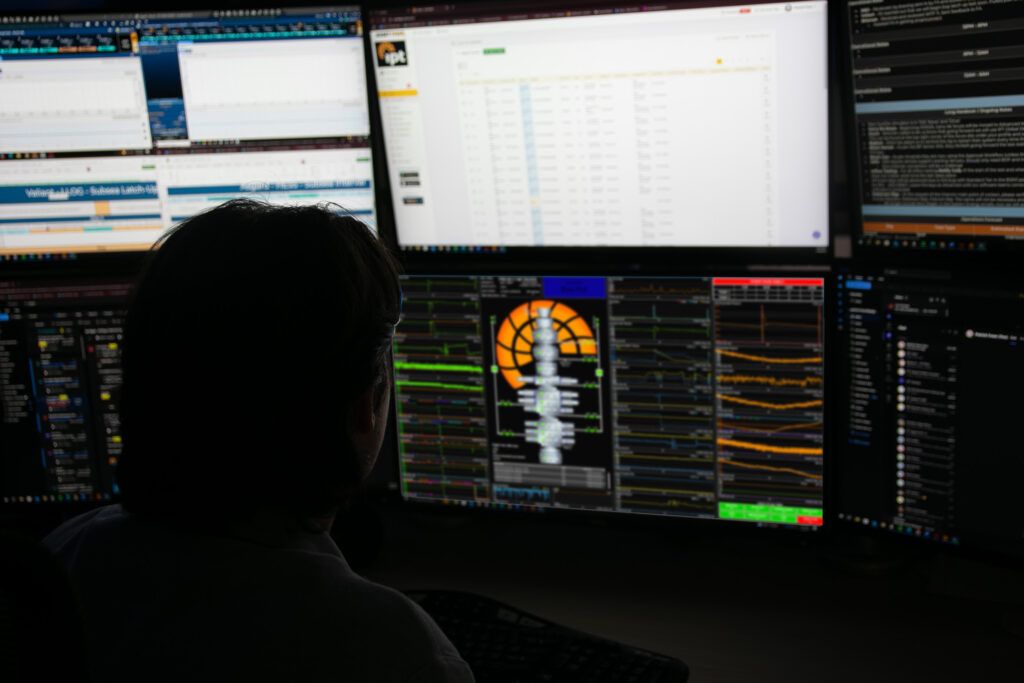
Operators must comply with strict regulatory standards and recommended practices for well integrity monitoring and reporting. Non-compliance can lead to fines, operational delays, or even well shutdowns. Data integration ensures that operators meet regulatory requirements more efficiently and comprehensively. By consolidating production data into a unified system, operators can generate regulatory reports more quickly, reducing the time and effort involved in manual data collection. This automated reporting process minimizes the risk of human error and ensures that all relevant data is captured accurately. Additionally, integrated data systems offer real-time updates on well integrity status, enabling operators to respond swiftly to emergencies and remain compliant.
Well integrity management requires close collaboration between various teams, including engineers, operations staff, and safety personnel. Effective communication between these groups is critical for promptly identifying and resolving well integrity issues. When data is spread across multiple applications, teams often rely on phone calls and emails to share updates, which can lead to delays and miscommunication. Data integration addresses this challenge by providing all teams with real-time access to the same information. This unified data view eliminates silos, enabling teams to collaborate more effectively and identify potential issues sooner. Additionally, integrated data systems allow for single updates across platforms, ensuring that all teams can make informed decisions using the most current data without needing to switch between multiple sources.
The digital transformation in the oil and gas industry is progressing rapidly, with companies increasingly leveraging technologies such as artificial intelligence (AI), machine learning, and the Internet of Things (IoT) to optimize well operations. Central to this transformation is data integration and the preparation of data for AI analysis, which forms the foundation for applying advanced analytics to well integrity data. For example, AI-powered analytics can process vast amounts of historical well integrity data to uncover trends and anomalies that humans may overlook. These insights can then be used to inform maintenance strategies, optimize well operations, and improve safety.
Data integration is crucial for effective well integrity management. By consolidating information from well design, construction, and continuous monitoring, operators can enhance their understanding of well health, leading to more informed decision-making and improved safety. Data integration enables the use of predictive analytics to anticipate equipment failures, mitigate risks, and reduce downtime. It also supports the development of unified applications that consolidate, integrate, and automate well integrity management workflows. Moreover, data integration simplifies regulatory compliance by enabling faster and more accurate reporting and incident response.
Collaboration among teams is significantly improved as all members gain access to real-time data, breaking down communication barriers. As the oil and gas industry increasingly embraces AI and IoT technologies, data integration will continue to be essential for optimizing operations and ensuring safety.
At IPT Global, we are dedicated to helping organizations tackle data integration challenges. Our team of experts is ready to assist you in streamlining your data processes and maximizing your operational potential. Contact us today to discover how we can support your data integration needs!
IPT Global and Horizon56 have collaborated to deliver an integration designed to enhance efficiency and assurance during operations. With the integration of IPT Global’s SureTec® Platform and Horizon56’s RigFlow, operators can now visualize live pressure tests in real-time alongside other critical operations, all within a single, streamlined platform.
The integration of IPT Global’s PressureTesting solution within Horizon56 RigFlow transforms the way operators view and manage their operations. With PressureTesting’s Remote View module (one of six within the PressureTesting solution) connected to Remote View part of RigFlow, users can monitor integrity assurance tests while executing DOPs—all from a single screen. Gone are the days of switching between platforms to access critical operational data.
This integration provides a holistic view of your operations, allowing operators to watch live pressure tests as they take place, check plan steps, and add comments in real time. By combining these capabilities into a single interface, Horizon56 and IPT make it easier than ever to ensure efficiency, accuracy, and smooth communication throughout the operation.
Watch live pressure tests as they occur within the broader scope of your operations. Stay updated in real time without switching between multiple systems or platforms.
Add comments and check off plan steps as they are completed, all within the same interface. The ability to communicate directly on each step enhances clarity and reduces the risk of miscommunication.
Operators and rig crews can visualize every step of the process in real time, ensuring that all operations are being carried out in the correct order.
By consolidating rig operations across different software platforms into one interface, this integration significantly reduces inefficiencies, helping to improve workflow and reduce errors.
One of the biggest challenges in operations is managing different processes tracked across various platforms. This can lead to gaps in communication, errors, and inefficiencies. The integration of IPT’s Global’s SureTec platform and PressureTesting solution with Horizon56’s RigFlow addresses this issue by providing a seamless, real-time view of all critical operations.
With Horizon56 and IPT Global, you can be assured that your team has access to all necessary information for efficient well operations—whether it’s pressure test results, operational steps, or direct communication with your crew.
If you’re ready to take your operations to the next level with real-time insights and unified platform, contact us today to learn more about the integration between IPT Global’s SureTec and Horizon56 RigFlow.
Ensuring well integrity is critical in offshore operations to ensure safety and efficiency in oil and gas production. Pressure tests are vital for confirming that well components can withstand the pressures encountered during operations. Just as important are the reports that document these tests, serving as a historical record and helping track the well’s performance over time. Implementing a digital pressure testing solution with integrated reporting capabilities and adhering to best practices for report generation, ensures the data is accurate, clear, and compliant with industry standards.
A major challenge in pressure test reporting is ensuring data accuracy, as errors in data collection or transcription can lead to incorrect assessments of well integrity. Digital pressure testing software, such as IPT SureTec, addresses this issue by automatically converting test data into reports, ensuring the information is accurate, complete, and consistent.
Regular audits further ensure that these reports meet regulatory standards, helping companies avoid fines and penalties.
IPT’s software streamlines testing data into digital reports.
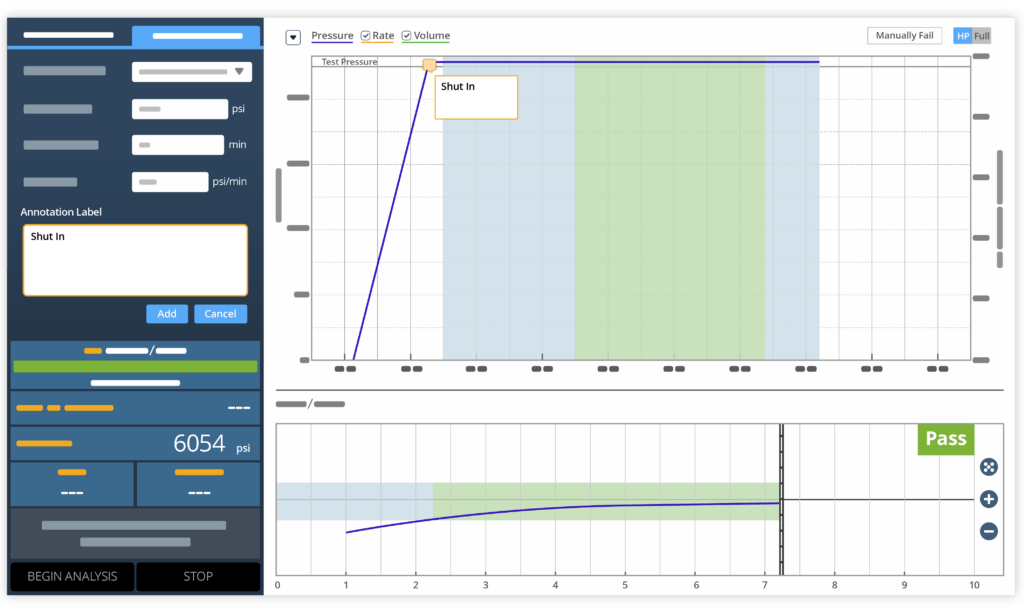
Pressure tests may sometimes provide results that are unclear or on the edge of acceptable limits when readings fluctuate or are close to preset thresholds. To address this, detailed documentation of test conditions and consultation with experts are essential to determine if further testing is needed.
IPT SureTec’s digital testing software enables detailed notetaking during testing, ensuring clear documentation of uncertainties, which supports informed decision-making regarding well integrity.
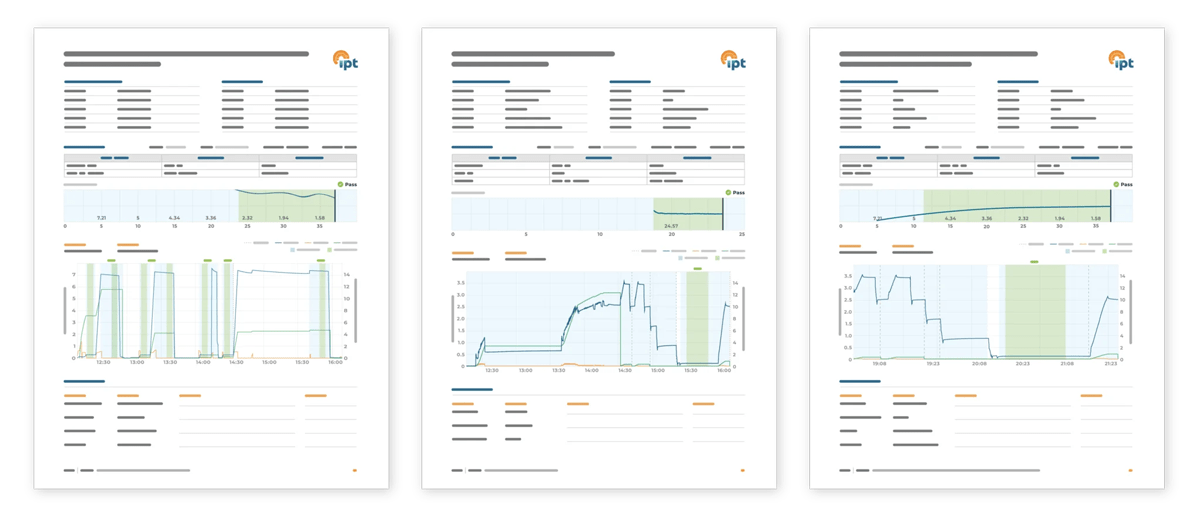
A major challenge is ensuring consistent documentation across various test types and wells. Variations in report formats or terminology can cause confusion and make it hard to compare results. Standardized templates and report structures resolve this issue by ensuring that the same format is used for all tests.
IPT provides standardized test reports, making it easier to interpret and compare results across multiple tests.
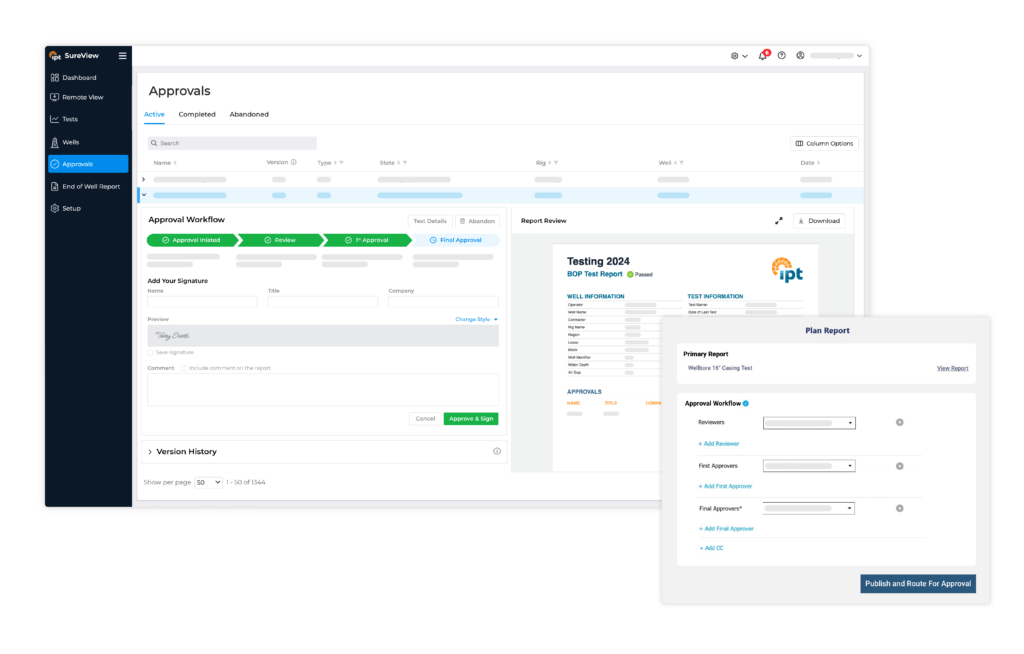
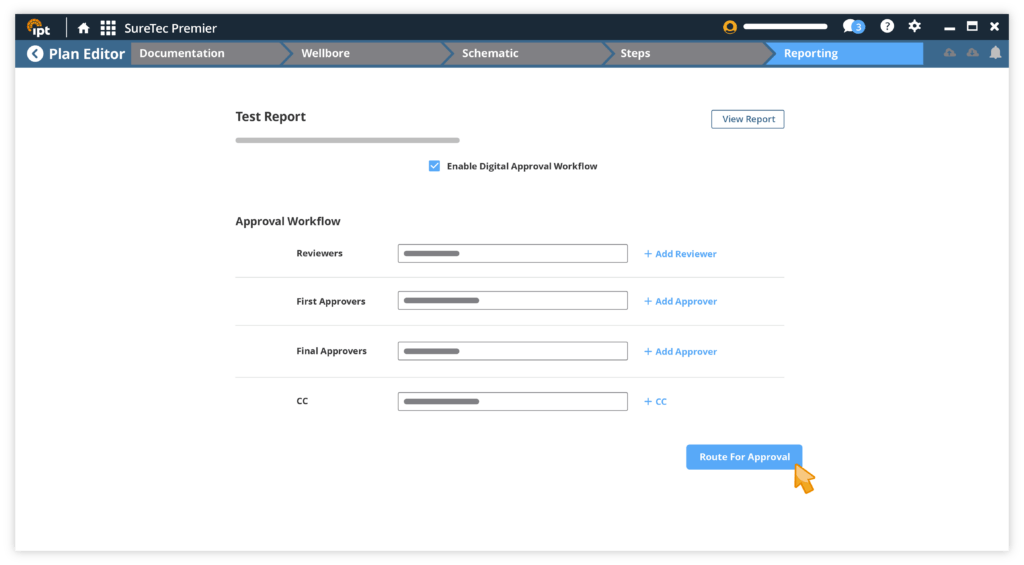
Test plan reports and test results must be submitted to key stakeholders for review, approval, and signatures. Traditional manual paper-based processes for approving reports often result in delays, lost documents, and version control issues. Ensuring traceability during report handover and approval is crucial for regulatory compliance, while accountability and transparency also enhance business processes.
Digital approval and handover processes reduce the risk of delays, lost paperwork, and version control issues, ensuring reports are quickly approved and stakeholders have access to the most up-to-date version. IPT’s software enables digital distribution of test reports for instant approval, with an audit log tracking all approval activities.
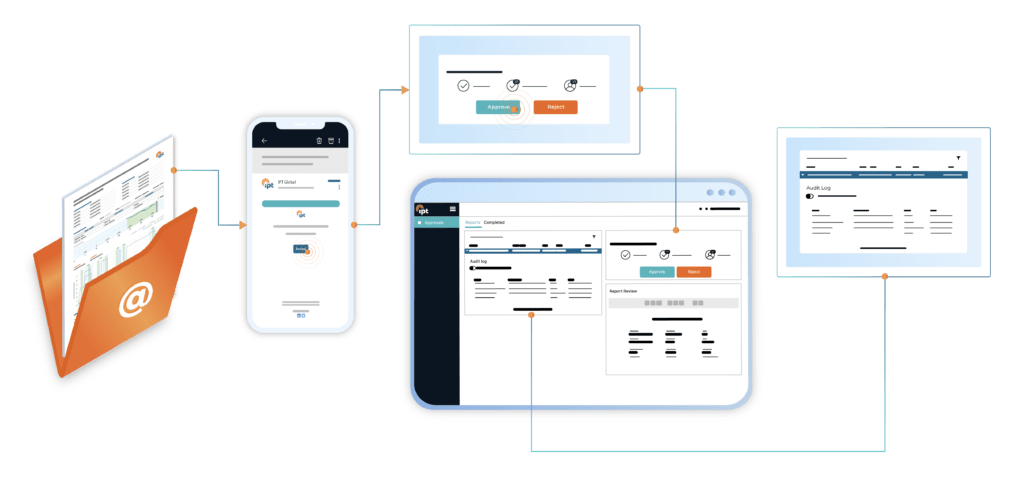
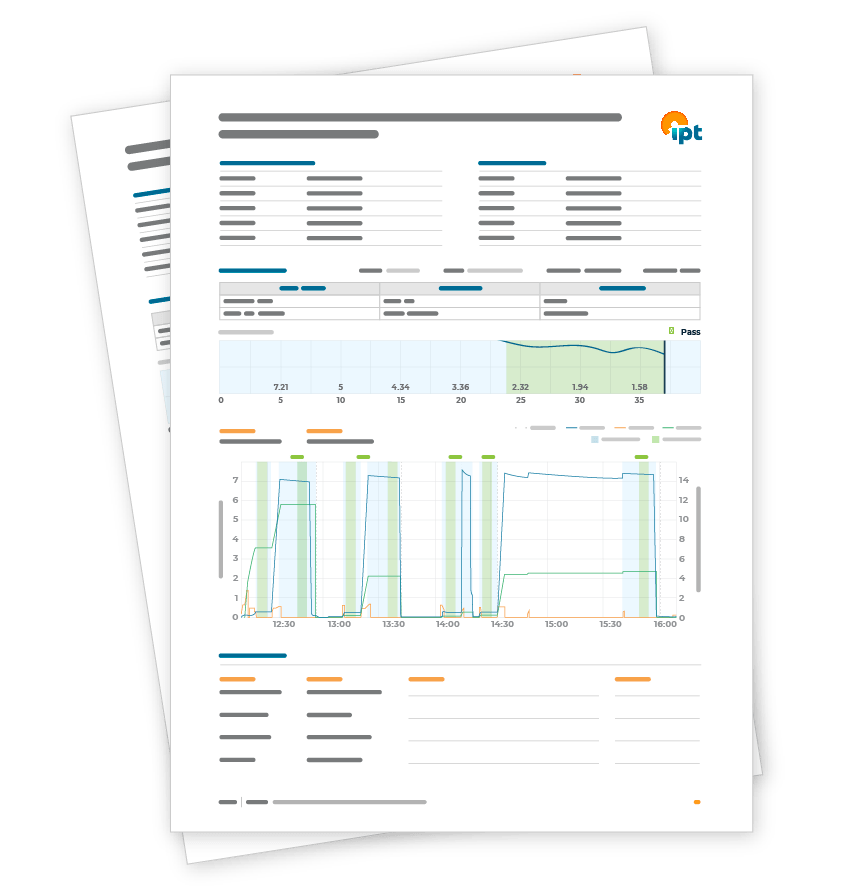
Utilizing IPT’s SureTec and SureView applications offers significant advantages in generating and managing well integrity test reports. SureTec is a desktop testing application, facilitating the creation of test plans and executing tests. It generates standardized reports, detailing each test step, including pressure graphs, schematics, and comprehensive documentation of tested components. With built-in compliance features, SureTec ensures that all reports meet industry standards and regulatory requirements. Test plan and test reports can be routed instantly from the platform upon completion of setting up a test plan or running a test.
Testing data, reports, and analytics are stored in IPT’s cloud-based SureView application, which also supports watching tests remotely in real-time. SureView includes an audit log for tracking all approval activities and allows digital distribution of reports for handover and approval. It also facilitates long-term data storage and easy retrieval, ensuring seamless access to historical test data.
Effective pressure test reporting is crucial for maintaining well integrity and operational safety. Leverage IPT’s solutions to streamline the process, enhance data accuracy, ensure documentation consistency, and simplify handover and approval workflows. For more information on how our digital solutions can enhance your well integrity management, contact us today.
Artificial intelligence (AI) is transforming oil and gas operations by enhancing efficiency, improving decision-making, and reducing risks. However, the success of AI applications depends on high-quality, well-managed data. Preparing data for AI analysis requires strategic planning and adherence to best practices to ensure data is accurate, complete, and suitable for complex AI models. Here are key best practices that companies should adopt to ensure their data is ready for AI applications.
In the oil and gas industry, various data formats can hinder AI applications, which thrive on consistency. Implementing standardized data schemas and company-wide data exchange protocols (e.g., WITSML, PRODML) ensures data is uniform and interoperable, making it easier for AI systems to analyze. Standardization simplifies preprocessing for AI and enhances compatibility.
In the oil and gas industry, various data formats can hinder AI applications, which thrive on consistency. Implementing standardized data schemas and company-wide data exchange protocols (e.g., WITSML, PRODML) ensures data is uniform and interoperable, making it easier for AI systems to analyze. Standardization simplifies preprocessing for AI and enhances compatibility.
AI algorithms need comprehensive and accurate data to provide meaningful insights into oil and gas operations. Fragmented or missing data can reduce the reliability of AI applications. A key step in ensuring data integrity is conducting routine data audits to catch missing, duplicated, or inaccurate records. These audits can identify and address incomplete or inaccurate data sets that could otherwise distort AI models and lead to faulty conclusions.
Data governance defines who is responsible for managing data, how it is accessed, and how it is protected. Strong governance ensures compliance with industry standards and protects sensitive information. Achieving AI readiness requires a solid governance framework to securely manage data collection, storage, and access. Establish a dedicated data governance team to oversee roles, responsibilities, and data access controls, ensuring secure and consistent data management practices.
A data lake is a centralized repository for storing raw historical and real-time data in its native format until it’s needed for analysis, without requiring prior structuring or processing. In the oil and gas industry, large volumes of structured and unstructured data are generated, such as seismic data, well logs, production information, and well integrity test data. While structured data is well-organized and easy to search, unstructured data is less organized, making it harder to analyze using traditional methods. To address this, companies should leverage cloud-based data lakes to centralize data storage in its raw form, enabling AI models to more easily access and process data from various sources.
Supervised learning is a machine learning approach where an AI model is trained using a labeled dataset, which includes both inputs and corresponding known outputs (labels). For example, if images of cars and planes are the input, the output label would specify whether it’s a “car” or “plane.” The model’s goal is to learn patterns between the inputs and outputs to accurately predict outcomes for new, unseen data.
In the case of a predictive maintenance model for offshore rigs, labeled data is required to indicate whether equipment is in good or bad condition. Without proper labeling, AI predictions will be compromised.
To enhance the precision of AI models, companies should invest in both manual and automated data labeling processes to improve the accuracy of AI-driven models.
Protecting AI-ready oil and gas data from breaches or unauthorized access is a top priority considering the strategic importance of operational and geological data. Robust security measures, including encryption and access controls, are critical for maintaining the integrity of data used in AI applications. Companies must ensure their data security protocols are up-to-date and capable of protecting not only existing datasets but also the increasing volumes of data that future AI applications will depend on.
Protecting AI-ready oil and gas data from breaches or unauthorized access is a top priority considering the strategic importance of operational and geological data. Robust security measures, including encryption and access controls, are critical for maintaining the integrity of data used in AI applications. Companies must ensure their data security protocols are up-to-date and capable of protecting not only existing datasets but also the increasing volumes of data that future AI applications will depend on.
The volume of data used in oil and gas AI applications is constantly expanding. As AI adoption grows, so will the demands on data storage, processing power, and bandwidth. Being AI-ready means ensuring that your data infrastructure can scale with the volume and complexity of data. By leveraging scalable cloud solutions, companies can manage growing data volumes while maintaining the flexibility to adapt to evolving AI requirements.
Oil and gas companies can position themselves for AI success by standardizing data formats, ensuring data completeness and accuracy, implementing strong governance, and utilizing scalable cloud solutions. For more information on preparing your well integrity data for AI, contact us today.
Well Interventions may be performed to add or restore production or to fix a well integrity issue. Expected production gains from deep and ultra-deep subsea wells must justify the cost of offshore intervention vessels and crews. Light well interventions are more common and cost-effective because they can be performed with minimal shut-in of the well. Light well interventions include, but are not limited to, acid stimulation; sand, scale, or hydrate removal; and gas lift remediation. In light well interventions, tools or sensors are lowered into a live well using slickline, wireline, or coiled tubing while pressure is contained at the surface. Service companies can perform light well intervention operations through subsea wellheads using riser or riserless methods while using a ROV to perform the operation and guide the landing of the well intervention equipment as shown in the stimulation example below.
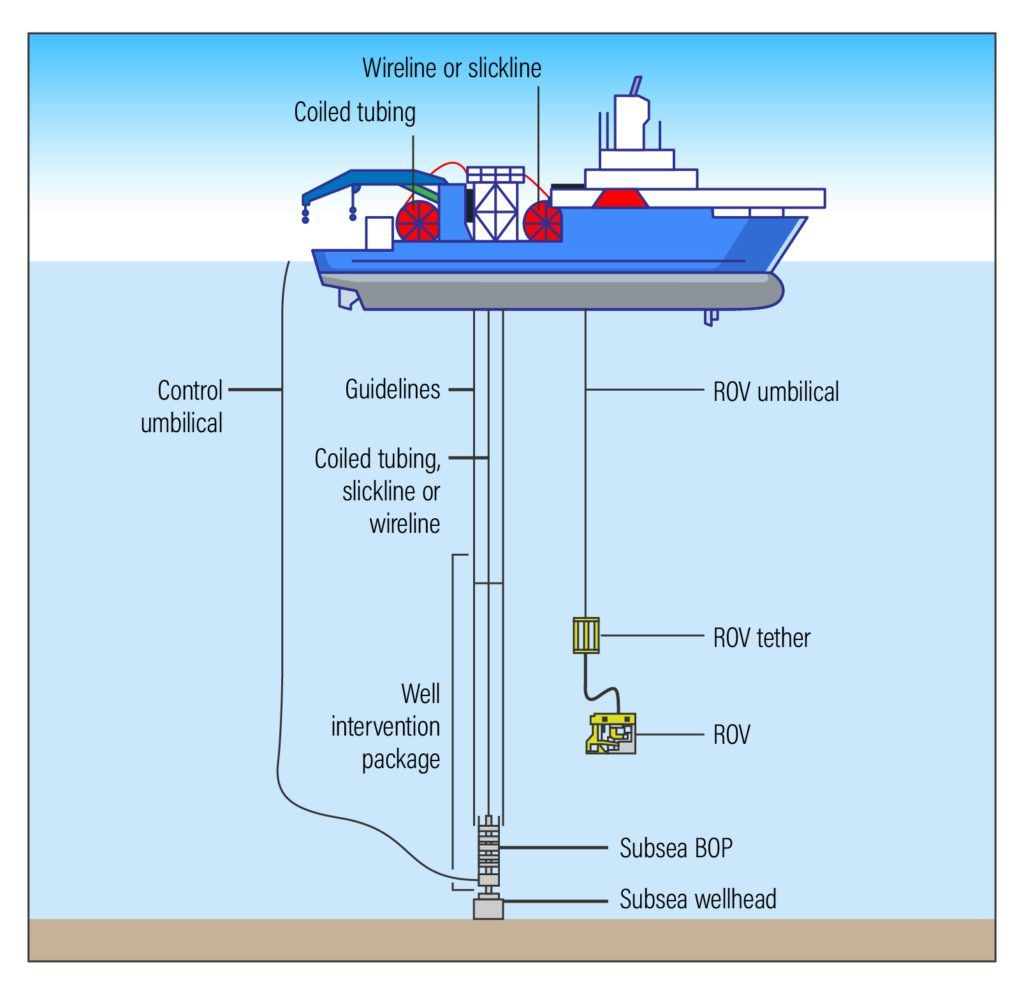
Each intervention program has specific objectives, operational steps, and associated risks. To enhance the safety, reliability, and assurance of the program, IPT offers integrity testing and assurance for a wide range of systems and components.
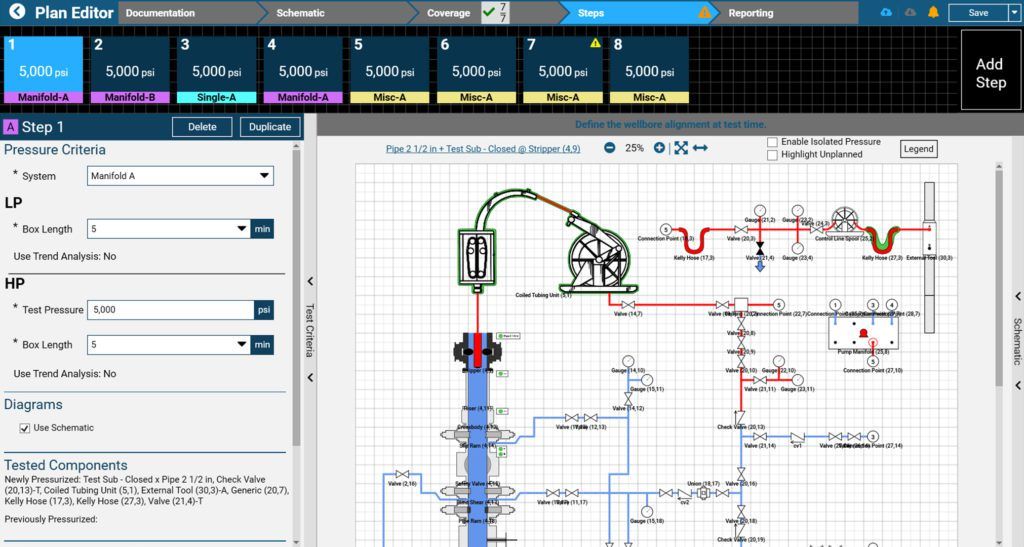
Subsea well interventions involve many challenges and require comprehensive planning to mitigate risk. IPT’s SureTec application is a single solution that handles all facets of integrity test planning for intervention operations. Interventions require a large number of integrity tests with varying criteria to be performed over a relatively short period. SureTec improves efficiency and project management, and it reduces risks by allowing operators to use consistent and stringent criteria for validating integrity-critical WBEs.
SureTec’s planning tools allow designers to build interactive schematics, wellbore diagrams, and test plan steps for stump, BOP, deck, coil tubing, positive and negative (inflow) test plans. SureTec’s Schematic Editor provides drag-and-drop components that accurately depict the operation of surface and subsea equipment. These schematics are integrated seamlessly into test plans that clearly identify test criteria and precisely simulate valve states and pressurized paths as shown in the following figure.
IPT’s support includes a Real-Time Operation Center (RTOC) staffed by engineers and experienced advisors (RTOAs). Our engineers assist operators and intervention service companies by building test plans in SureTec that accurately represent their testing program. An engineering team member can also create a test matrix that provides a snapshot of all tests and criteria as well as guidelines that help the production and intervention crews with hardware setup. Our RTOAs are responsible for reviewing intervention test plans to ensure all critical components are tested to the appropriate pressure.
IPT’s support includes a Real-Time Operation Center (RTOC) staffed by engineers and our Field Our Field Service Quality Advisors (FSQAs) or trained intervention service company personnel use SureTec to perform pre-deployment activity testing of the well intervention equipment, the manifold, and other surface iron to assure that the intervention tools and well control components work properly prior to their deployment on the vessel. SureTec provides component integrity assurance with high digital resolution and stringent test criteria. Digital resolution and sensor accuracy are vital because high measurement sensitivity is required to detect small pressure changes in control lines, and small-volume cavities and annular spaces.
Upon the vessel’s arrival at the well, our FSQAs or trained rig crew use SureTec to ensure the integrity of the system that will connect to the well as this system will protect people, equipment, and the environment during the latch up phase.
During installation on the seafloor, the tree cap is removed, and the well stimulation tool is connected (latched) to the subsea tree. After the well access tool is latched up (e.g., a stimulation tool), IPT performs a connector test to verify the integrity of the system.
During intervention operations, integrity tests must be performed thoroughly and efficiently because any avoidable delay in critical path operations can increase risk and be costly for both the intervention service company and the operator. Efficient testing of critical components requires the ability to connect to various sources and run multiple tests simultaneously. SureTec receives data from multiple sources such as the IPT transducer, ROV transducer, ROV control system, and Workover Control System. Users can enter Multi-Test mode to execute up to four test plans simultaneously, each with a different pressure source and test criteria. Users can start, stop, and restart analysis for each test independently.
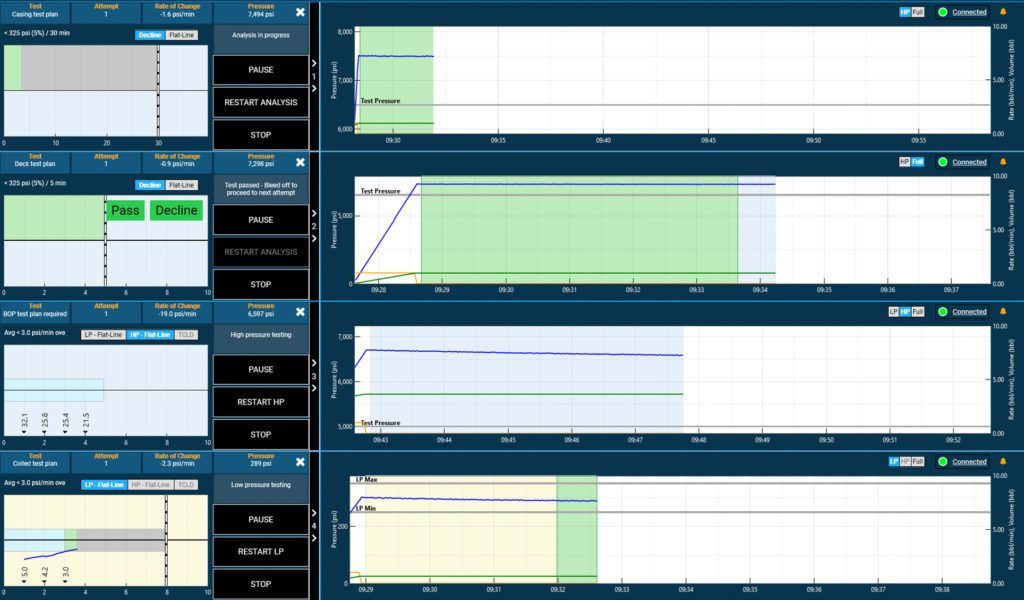
After the intervention is completed, the operator also needs traceability of all integrity tests to hand off to the production team and to have an auditable trail of compliance with local regulatory bodies. When each test is completed or stopped, SureTec generates a standardized, detailed report of each test step, including pressure graphs, schematics, and complete documentation of tested components. Our RTOAs review the test files to ensure all tests passed and all components were tested to proper pressures. They also verify the integrity of barriers before the intervention team departs.
The documented data and lessons learned from each intervention fosters an environment of continuous improvement and delivers the highest-level integrity assurance to operators, production operations, and intervention service companies.
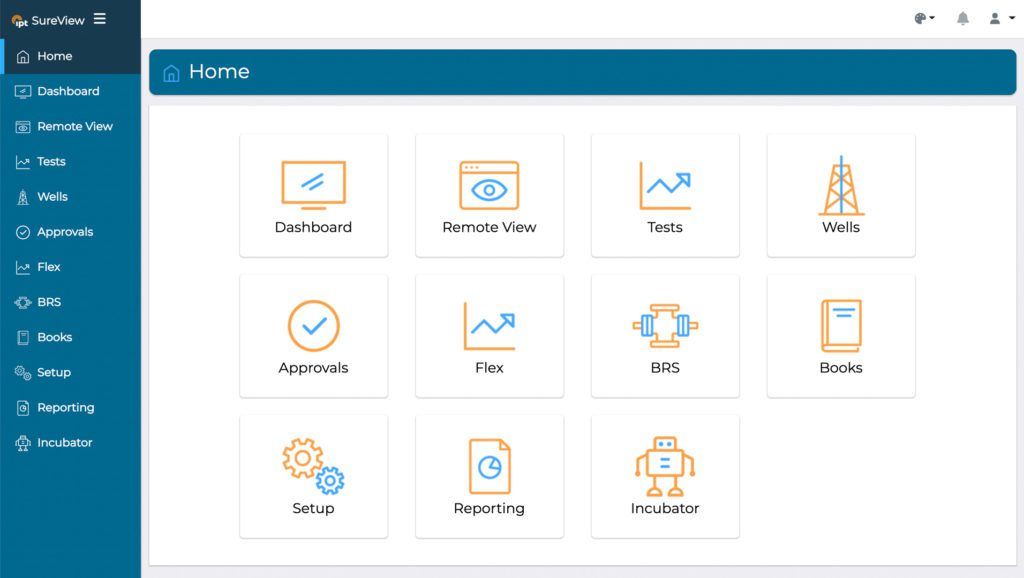
Operators’ intervention and production teams can use IPT’s SureView application for report archival and traceability over the entire lifecycle of the well. SureView is a secure, web-based tool that provides real-time status of pressure tests, test data organization and retrieval by well and date, advanced data analysis, and remote viewing of active tests. SureView’s interactive search features simplify retrieval of historical test data for review and analysis.
IPT’s comprehensive planning, test execution, and reporting tools combined with our team of experts contribute to better management and mitigation of potential risks leading to improved performance and greater assurance of well integrity during well interventions. Contact us to discuss your well interventions.
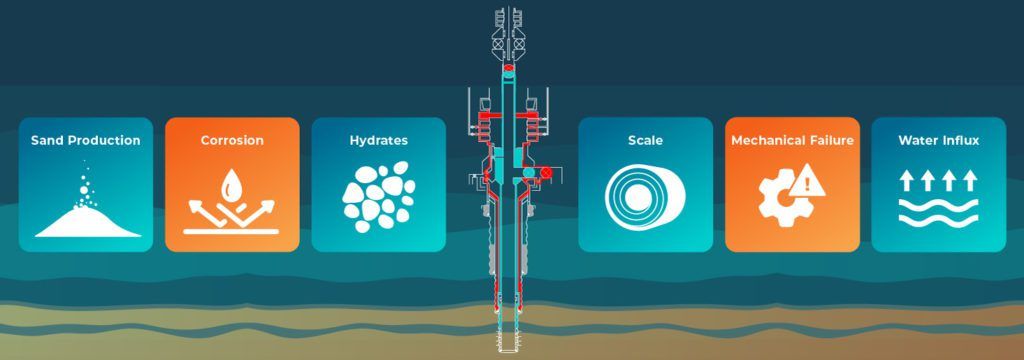
Technological advances in offshore drilling have aided in overcoming well intervention challenges, increasing the number and total depth of wells drilled in deep and ultra-deep water. Drilling in deeper water and at greater depths increases operators’ risk and reduces the margin of error regarding the protection of people and the environment. During drilling and completion of wells, IPT provides products and services that help assure well integrity and avoid well interventions to repair critical well components. However, as the number and age of deepwater wells increase, the need for interventions increases as well due to the onset of other conditions like sand production, corrosion, hydrates, scale, mechanical failure, and water influx. Each intervention is costly, and its outcome is uncertain. When interventions are necessary, IPT’s products and services also provide well integrity assurance.
Learn the risks and challenges faced by operators and intervention service companies when the decision is made to repair damaged or underperforming deepwater wells.
A well intervention involves taking the well offline and breaking the primary barrier of the subsea infrastructure and potentially the secondary barrier as well. The subsea infrastructure may have degraded after years on the sea floor. A single intervention costs millions of dollars and the cause of the well problem may not be completely known when the intervention process starts. Therefore, re-entering a previously secure well in extreme conditions introduces additional risk to people, the environment, assets, and the operator’s reputation.
When intervention becomes necessary, the operator is focused on managing the cost of reestablishing production while maintaining safety and regulatory compliance. The cost and complexity of interventions are directly proportional to water depth as it determines the size of the intervention vessel and crew required. The intervention crew typically visits multiple well locations for various operators on a single tour to maximize the operational functionality of the vessel. Although this complicates scheduling of the vessel, it allows the cost of intervention services to be split across operators, reduces the travel time to each well, and minimizes port and duty costs.
Due to cost and scheduling complexity, operators want to avoid repeating the intervention process and suffering lost production again for a given well. The operators want to ensure the intervention tools and well control components work properly prior to connecting to the well. After the intervention, the operator also needs traceability of all integrity tests to hand off to the production team and to have an auditable trail of compliance for local regulatory bodies.
Integrity testing of well components during interventions presents different challenges as opposed to testing during well construction. An intervention may only last a couple of weeks, so component integrity tests are performed more frequently than during well construction. Many offline integrity tests are performed simultaneously on the deck of the intervention vessel to eliminate delays once the crew connects to the well. During intervention, integrity tests must be performed thoroughly and efficiently because any avoidable delay in critical path operations would be costly for both the intervention service company and the operator. The final test in the intervention process is the inflow (negative) test on the surface-controlled subsurface safety valve (SCSSV), a critical component that provides fail-safe closure to prevent uncontrolled flow in the case of catastrophic damage to wellhead equipment. A major challenge in the industry has been the lack of consistent test criteria by which to determine if the final inflow test passes or fails. This leads to inconsistent test results across rigs.
Post intervention, communication between the intervention service company and the production operations crew about the status of the well and the integrity of the well components is critical to a successful handover. Many problems and accidents have occurred due to poor handover documentation or communication. The intervention service company must provide accurate and comprehensive reports to all stakeholders.
IPT’s products and services perform and track integrity tests on well components, ensuring transparency during handover between intervention and production stages, and providing an auditable trail should any forensic work be required. Contact us to learn more about how IPT’s products and services assure the success of well interventions.
For over a century, the oil and gas industry has relied on outdated technology and individual experience to interpret pressure tests that are critical to verifying well integrity for the protection of personnel, the environment and equipment.
Digital pressure testing provides an objective interpretation using accurate and high-resolution data that is tamper-proof and auditable. Additionally digital data allows for cloud-based archival of the well history and KPI tracking to make performance visible to identify learning opportunities, and close process safety gaps while reducing opportunities for human error.
An important and visible change associated with digital data was the move 10+ years ago away from circular chart recorders (CCR). In 2020, IPT worked with a major oil and gas operator to run a direct comparison between CCRs and the IPT approach of digital pressure tests provided through SureTec.
A major client with active, global operations offshore and onshore sought to address: “how to standardize assurance and efficiency across all business units and projects?”
This was the perfect time for IPT to work with the client to improve integrity validation workflows, from planning and execution to after-action reviews and data archival.
IPT ran a comprehensive comparison trial of CCRs vs. digital pressure tests provided by IPT’s software SureTec across four of the operator’s rigs. Our well integrity advisor led after-action reviews with rig and office teams.
With the goal of standardizing the validation workflow, we highlighted operational changes during the test, deviations outside of API standards and specific KPIs on time breakdown for online and offline testing. The cloud-based data storage enabled rapid performance analysis.
IPT and our client agreed on several KPIs and objectives for the trial. SureTec provided integrity, assurance, performance and compliance not possible using an analogue approach and CCR. The trial highlighted the opportunities and influenced new standards and process improvements.
Benefits to the level of assurance provided by SureTec included:
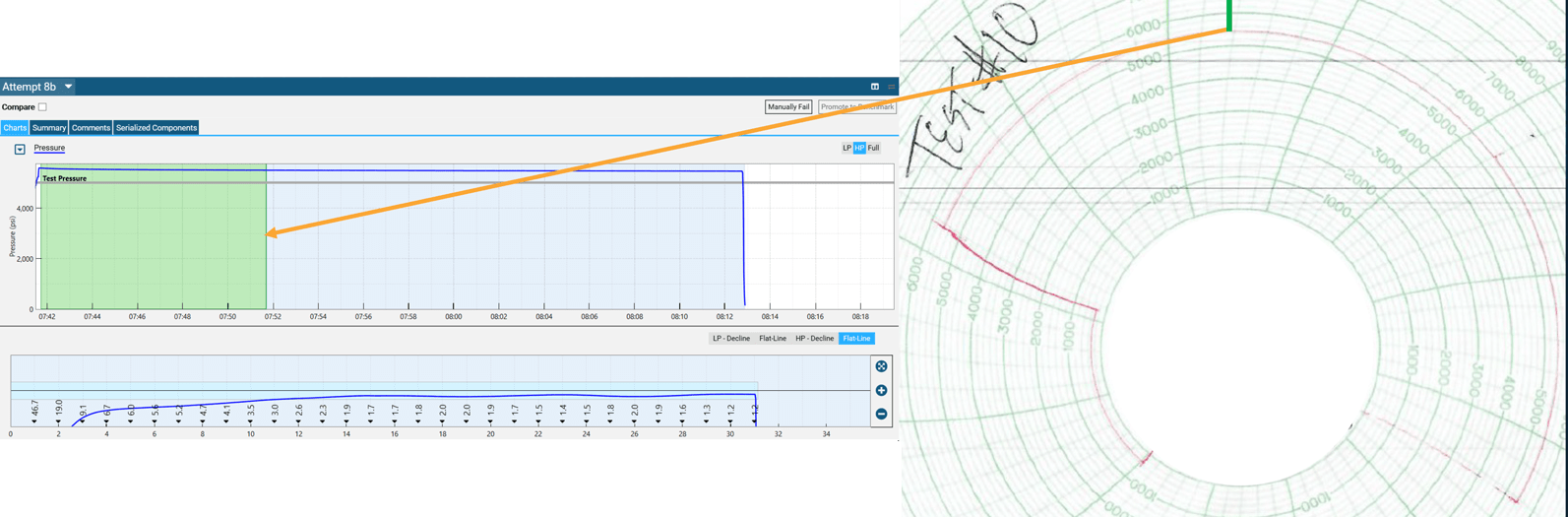
API Std 53 requires that a low-pressure test shall pass between 250-350 psi. The images in figure 1 demonstrates the CCR test passed at 409 psi. The lack of detail from the CCR does not clearly demonstrate small discrepancies with the regulations and leaves the results open to interpretation.
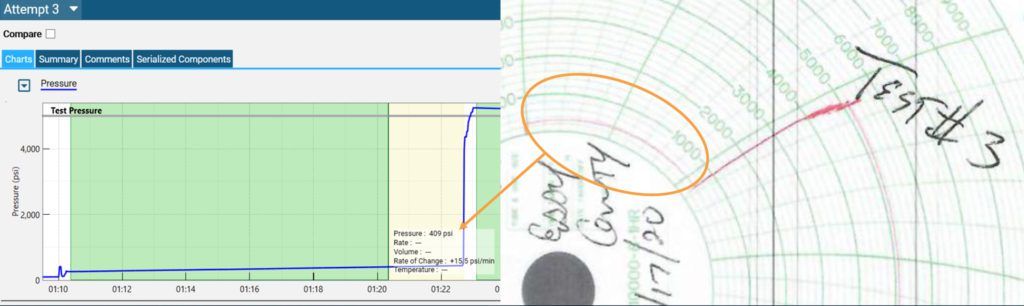
Illustrated in the Figure 2, the test passed the approved criteria at minute 10 (SureTec). The test was then held out for an additional 21 minutes on the CCR. This additional time was caused by the subjective review by the tester.
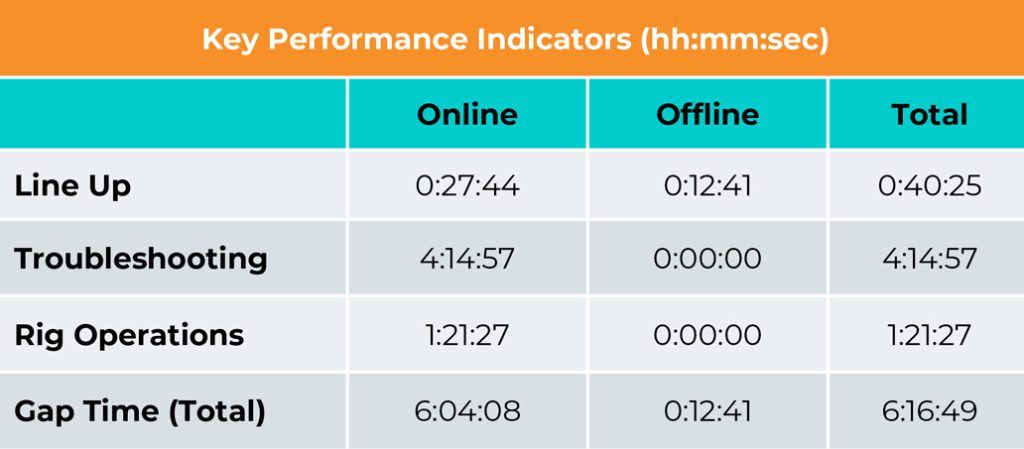
The below table (Figure 3) provides details on gap time analysis. Understanding and tracking these gap times helps drive efficiency and lessons learned.
IPT partnered with a global operator to drive integrity and assurance standardization across its business units by introducing digital pressure tests utilizing the industry-leading technology software, SureTec.
IPT’s solutions provided objective, tamper-proof and auditable results for well barrier integrity validation. Process and performance opportunities were easily identified that were used to make sustainable changes to programs and standards.
During the implementation of SureTec, our client said, “I’m so happy we are making the switch. Using this digital tool and being involved in the digital transformation is critical for assurance and driving efficiency.”
Let IPT be a part of your digital transformation and benefit from the application of digital data to drive efficiency and improve assurance.
Negative pressure testing, also know as inflow testing, offers oil and gas companies a reliable way to test well barrier integrity. These tests are so critical that regulators have stepped in to require them via the Code of Federal Regulations (CFR) Title 30 § 250.721(g). During a negative pressure test, displacement occurs through the use of a lower density completion fluid, and with pressure lowered, the well barrier is monitored for leaks. The process is highly controlled, which makes these tests incredibly safe to perform.
The upsides to negative pressure testing are numerous. Yes, such tests are required for anyone who operates an oil or gas well, but they should be viewed as gifts rather than curses. They’re an effective tool for ensuring safety at the drill site, enabling efficient operation of a well and avoiding costly damage down the line.
Here are a few reasons for why negative pressure testing is so important.
The wellbeing of the crew should be top-of-mind for any oil or gas company, whether workers are stationed on an oil rig or spend their time at some other type of well. Drilling is a risky job, as is maintaining a live well. Every step should be taken to ensure your team is protected, and that starts by keeping a close eye on every potential failure point.
Negative pressure tests can identify well barrier integrity issues before they develop into something more serious. If a leak exists, the test will catch it, giving you an opportunity to address the issue and possibly prevent injury or — in the case of a catastrophic blowout — loss of life. That is reason enough to take these tests seriously.
The purpose of your well is to extract oil or gas from the earth, and to do so efficiently. You want optimal performance — a benchmark you can’t achieve if there are issues with well barrier integrity.
If you fail a negative pressure test, that is a sure sign the well production recovery process is being impacted. When that’s the case, you are operating inefficiently, consuming the same amount of energy while falling below your peak recovery potential. Regularly scheduled tests help you diagnose slips in performance — even before you reach the point of failure — so you can make improvements and keep your well operating at a high level.
Not every well barrier breach develops into a disaster. In fact, some simply render a well inoperable for a not-insignificant period of time while repairs are made to fix what’s broken. This is what makes a proactive process like negative pressure testing so crucial. By performing tests at regular intervals, you can get a sense of how your well barrier is going to hold up in the future.
Negative pressure testing grants you knowledge about which aspects of the barrier are in good shape, and provides insight into where integrity is starting to slip test after test. With this data in hand, you can plan for maintenance ahead of time instead of being forced into it at a moment’s notice. Should some sort of failure occur, you could be looking at costly repairs and replacements. Reconditioning your system while everything is still intact will save you a lot of time and a lot of money.
IPT has decades of experience helping the oil and gas industry perform negative pressure tests. Countless companies rely on SureTec for consistent and accurate testing, and SureView for reviewing data and documenting trends both on-site and remotely.
Contact IPT today for more information on our digital testing solutions, and to learn more about how SureTec and SureView contribute to safe operation, efficient production, and cost-effective maintenance.
IPT Global had the privilege of collaborating with University of South Carolina Upstate Master of Science in Business Analytics students in their Spring 2022 MSBA 790 capstone course through an experiential learning partnership provided by CapSource.io. The project’s objective was calculating the greenhouse gas emissions savings we provide for our clients. This was a high-impact experiential learning project for students at the University of South Carolina Upstate with a legitimate industry case study and dataset. Experiential learning is a type of program that students, educators, and sponsoring companies can benefit from by creating impactful products that solve real industry problems. By the end of the project the students gained career experience in using key analysis skills with industry leaders who guided and provided meaningful feedback throughout the program.
Seven candidates from the Master of Business Analytics program at the USC Upstate College of Business and Economics were tasked with a visualization and research project developed by IPT Global to determine our client’s CO2 emissions savings. The project was guided by our Data Science Team Lead, Bryan Spencer, as the technical point of contact and project manager and Dr. Uma Gupta, the student’s professor and advisor. Throughout the project they helped provide insight and guidance.
The students were tasked with building a visualization tool or dashboard that allows the end user to quantify the greenhouse gas (GHG) emissions reductions from time savings gained using IPT Global’s software suite. These beneficial time reduction improvements were a result of efficiency in testing from the use of our proprietary algorithms and operational optimizations through remote monitoring, streamlined processes, and other IPT solutions. The students performed significant research to be able to estimate the overall GHG emissions from specific operations and discover how it impacts the overall carbon severity of an offshore oil and gas well.
Through guidance from the project manager of IPT Global, Bryan Spencer and the instructor Professor Uma Gupta, the students built a Tableau dashboard that was able to identify the GHG emissions reductions our clients received from using our SureTec software. The dashboard was able to differentiate between operations on jack-ups, semi-subs, and drillship rigs. In addition, the dashboard offered guidance on whether a rig could save more through further streamlining operations. The students investigated multiple operational factors to identify the optimal amount of savings a rig could obtain and compared it to current operation savings to identify room for improvement and future operational goals.
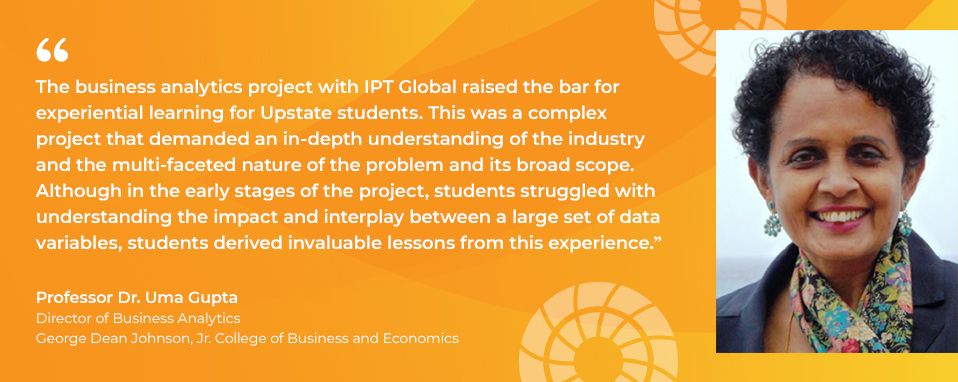
This project was very significant and beneficial to the MBA program at USC Upstate. Professor Dr. Uma Gupta stated this about the experience, “The business analytics project with IPT Global raised the bar for experiential learning for Upstate students. This was a complex project that demanded an in-depth understanding of the industry and the multi-faceted nature of the problem and its broad scope. Although in the early stages of the project, students struggled with understanding the impact and interplay between a large set of data variables, students derived invaluable lessons from this experience. The project was both inspiring, given the focus to reduce greenhouse gas emissions, and simultaneously challenging. The leadership of Cody MacDonald and Bryan Spencer is noteworthy. Program sponsors play an important role in the success of all projects. Bryan Spencer spent many evenings sharing his knowledge and guiding students to address the inevitable challenges that arise in a project of this nature. In his own gentle way, he prodded students to be intellectually curious and practical at the same time. USC Upstate is grateful for this partnership and looks forward to working with IPT Global in the future.”
IPT Global was grateful to work with the students at USC Upstate over the course of this project. We are looking forward to incorporating this work into our products and displaying the greenhouse gas emission savings for our clients on dashboards. This will show the immense value IPT provides in efficiency and environmental impact through emissions savings. Contact us to learn more about how we can make your operations more efficient and reduce your greenhouse emissions.